令和6年度 追・再試験 英語リスニング(音声付き)
全37問・100点満点。 各問題の「▶」ボタンでその問題の音声だけを再生できます。 解答すると正誤と配点が表示され、スクリプト全文(英語+日本語訳)と解説を確認できます。
第1問A
英語を聞き,それぞれの内容と最もよく合っているものを,四つの選択肢(①〜④)のうちから一つずつ選ぶ。音声は2回流れる。
問1
スクリプト・和訳・解説を見る
スクリプト
M: Sally, since you want something sweet, eat a banana instead of candy.サリー,甘い物が欲しいなら,キャンディーの代わりにバナナを食べなよ。
解説
正解は③。話し手は甘い物を欲しがるサリーに,キャンディーではなくバナナを食べるよう命令文で勧めているから。決め手は「eat a banana instead of candy」で,instead of A(Aの代わりに)により,勧めているのはバナナだとわかる。④はcandyという語だけを拾うと選んでしまうひっかけで,キャンディーは「やめるべきもの」の側。①と②は「since you want something sweet(甘い物が欲しいのだから)」と矛盾する。コツ: instead of の後ろは「選ばない方」を表すので,動詞の直後の目的語(banana)こそが勧められている物だと聞き分けよう。
問2
スクリプト・和訳・解説を見る
スクリプト
M: My meeting's starting now. It finishes at 2 pm. Is it possible for you to call me after that?会議が今から始まるんだ。午後2時に終わるよ。その後に電話をかけてもらうことはできるかな。
解説
正解は②。会議は今始まって午後2時に終わるので,その後なら電話で話せると述べているから。決め手は「It finishes at 2 pm. Is it possible for you to call me after that?」で,after that(その後で)=午後2時以降なら時間があるという②の言い換えになる。③はstarting nowとfinishes at 2 pmの組み合わせを入れ替えたひっかけで,2時は「終わる」時刻。④も「今終わる」のではなく「今始まる」ので逆。①は会議が今始まる以上,今は話せないので誤り。コツ: 時刻とstart / finishの組み合わせを正しくメモし,after thatのような指示語が直前の何を指すかを押さえよう。
問3
スクリプト・和訳・解説を見る
スクリプト
M: Look! The sky is getting clear! We can finally go home.見て!空が晴れてきたよ!やっと家に帰れるね。
解説
正解は①。空が晴れてきて「やっと帰れる」と言っており,帰るのをずっと待っていたことがわかるから。決め手は「We can finally go home.」で,finally(やっと・ついに)は長い間それができなかったことを含意し,①のhas been waiting to go homeの言い換えになる。④は「The sky is getting clear!」と逆で,天気はむしろ良くなっている。③は一日中晴れていたのなら待つ必要がなく,finallyと矛盾する。②はこれから帰るところなので誤り。コツ: finallyやat lastのような副詞は「それまで実現していなかった」ことを示す重要なヒントとして聞き取ろう。
問4
スクリプト・和訳・解説を見る
スクリプト
M: Did you hear? Laura's bicycle was stolen last week. Luckily, it was found this morning.聞いた?ローラの自転車が先週盗まれたんだ。幸い,今朝見つかったよ。
解説
正解は③。ローラの自転車が先週盗まれたと述べているから。決め手は「Laura's bicycle was stolen last week」で,受動態のwas stolenを能動態に言い換えると③のSomeone took Laura's bicycleになる。④はLauraを「盗んだ側」にした主客転倒のひっかけ。①はfoundという語を拾わせるひっかけで,見つけたのはローラではなく,「彼女の自転車が見つかった」が正しい。②は「it was found this morning(今朝見つかった)」と矛盾する。コツ: 受動態の文は「誰が・何を・される側か」を整理し,能動態への言い換えを予測しながら聞こう。
第1問B
英語を聞き,それぞれの内容と最もよく合っている絵を,四つの選択肢(①〜④)のうちから一つずつ選ぶ。音声は2回流れる。
問5
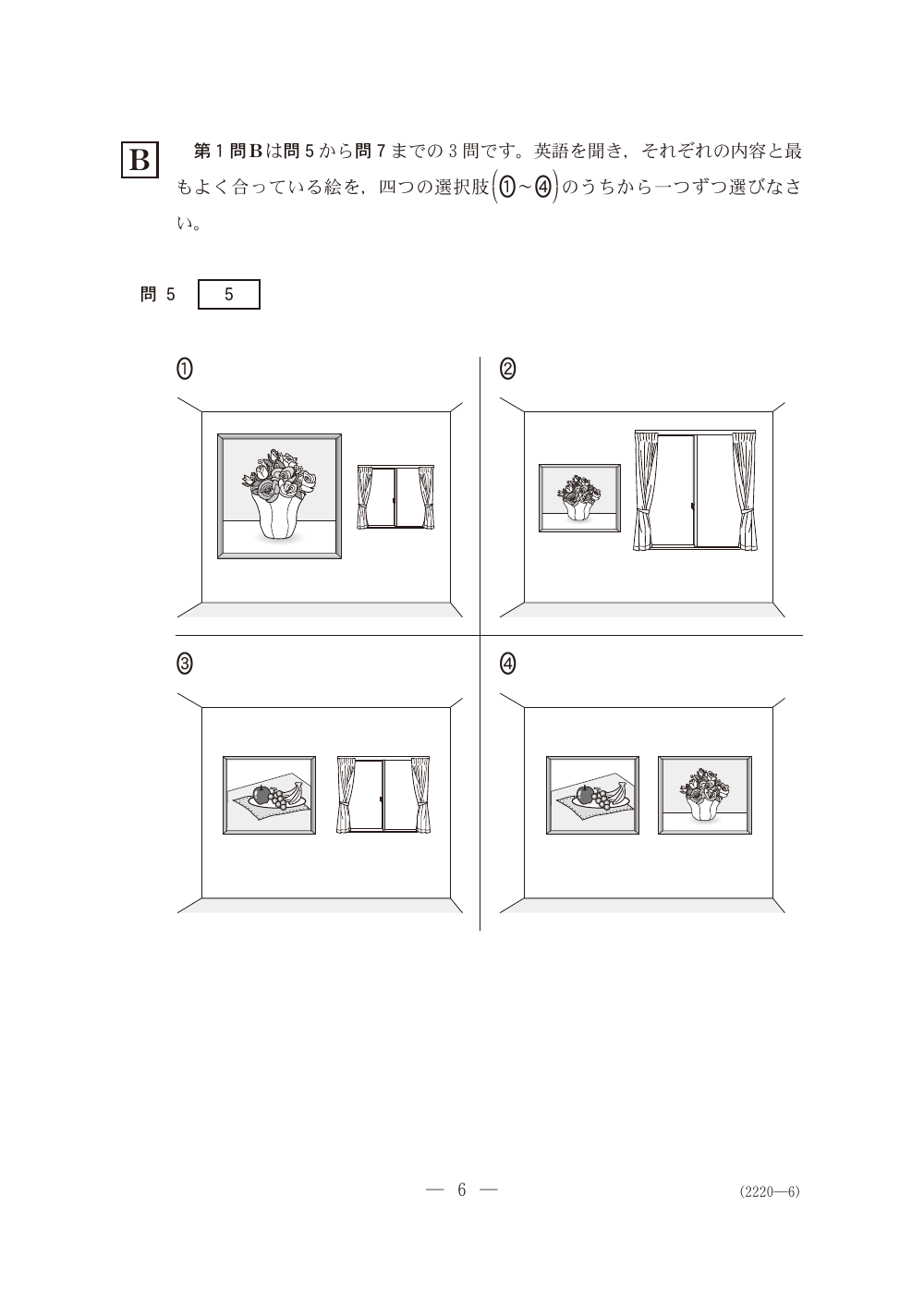
スクリプト・和訳・解説を見る
スクリプト
M: Wow! Your new picture is as big as the window. Nice!わあ!君の新しい絵は窓と同じ大きさだね。いいね!
解説
正解は③。新しい絵が窓と同じ大きさだと述べているから。決め手は「as big as the window」で,as ~ asの原級比較は「同じくらいの大きさ」を表すため,絵と窓が同じ大きさで描かれたイラストを選ぶ。絵が窓より大きいイラストや小さいイラストは,bigger thanやsmaller thanと言った場合であり誤り。コツ: 絵の比較問題では,as ~ as(同じ),比較級 than(より〜),the 最上級(最も〜)の3パターンを聞き分けることが決め手になる。pictureとwindowのどちらが比較の基準かも意識しよう。
問6
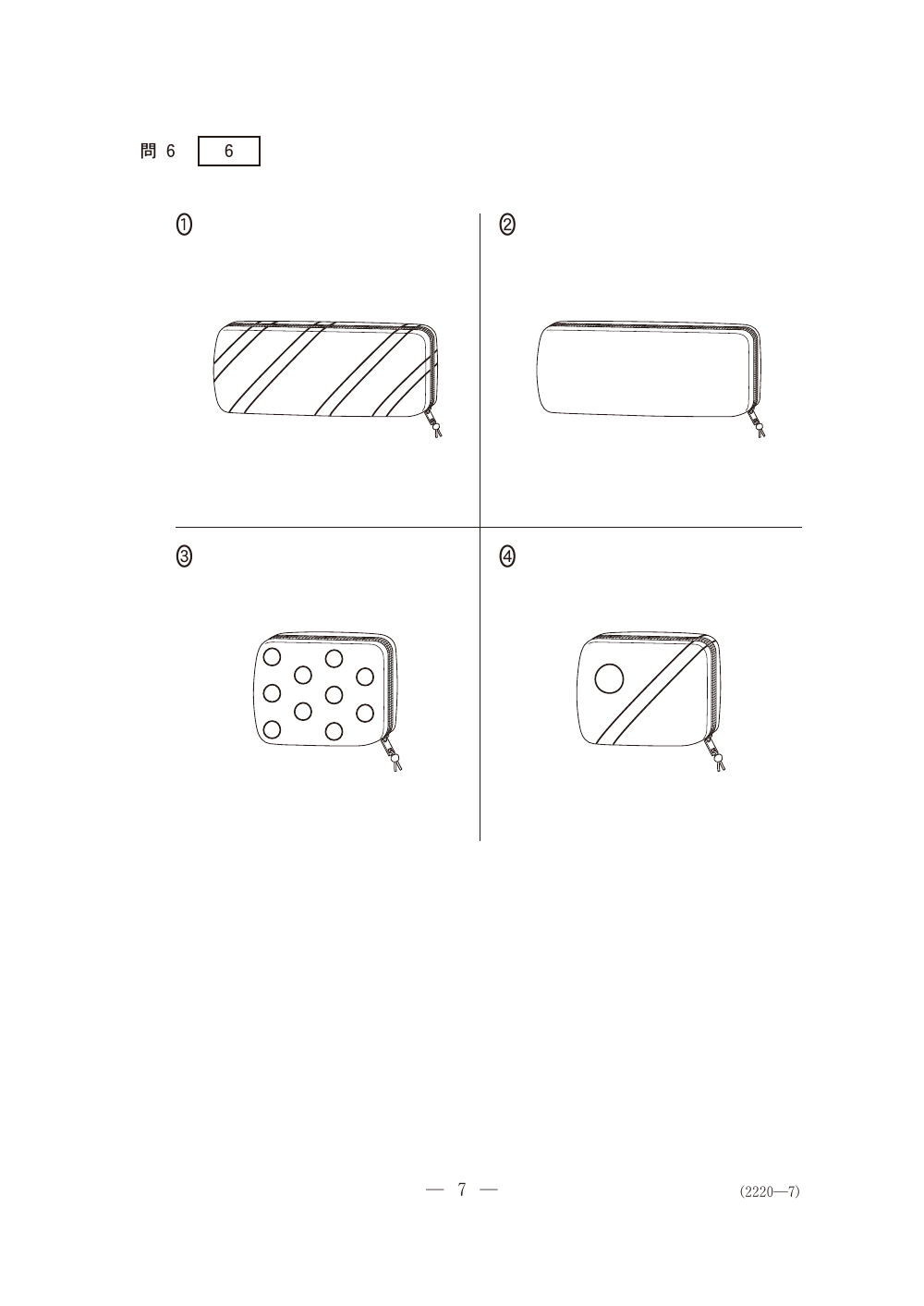
スクリプト・和訳・解説を見る
スクリプト
M: I like that wallet, the one without any stripes or circles.あの財布がいいな。しま模様も丸い模様もないやつだよ。
解説
正解は②。しま模様も丸い模様もない財布が欲しいと述べているから。決め手は「the one without any stripes or circles」で,without any A or Bは「AもBも全くない」という全否定になり,無地の財布を指す。しま模様の財布や丸い模様の財布は,聞こえた単語stripes / circlesだけを拾うと選んでしまうひっかけ。コツ: with / withoutの聞き分けが最重要で,withoutの後に出てくる名詞は「絵に描かれていないはずの特徴」だと頭を切り替えて絵を見よう。not any=noの全否定にも注意。
問7
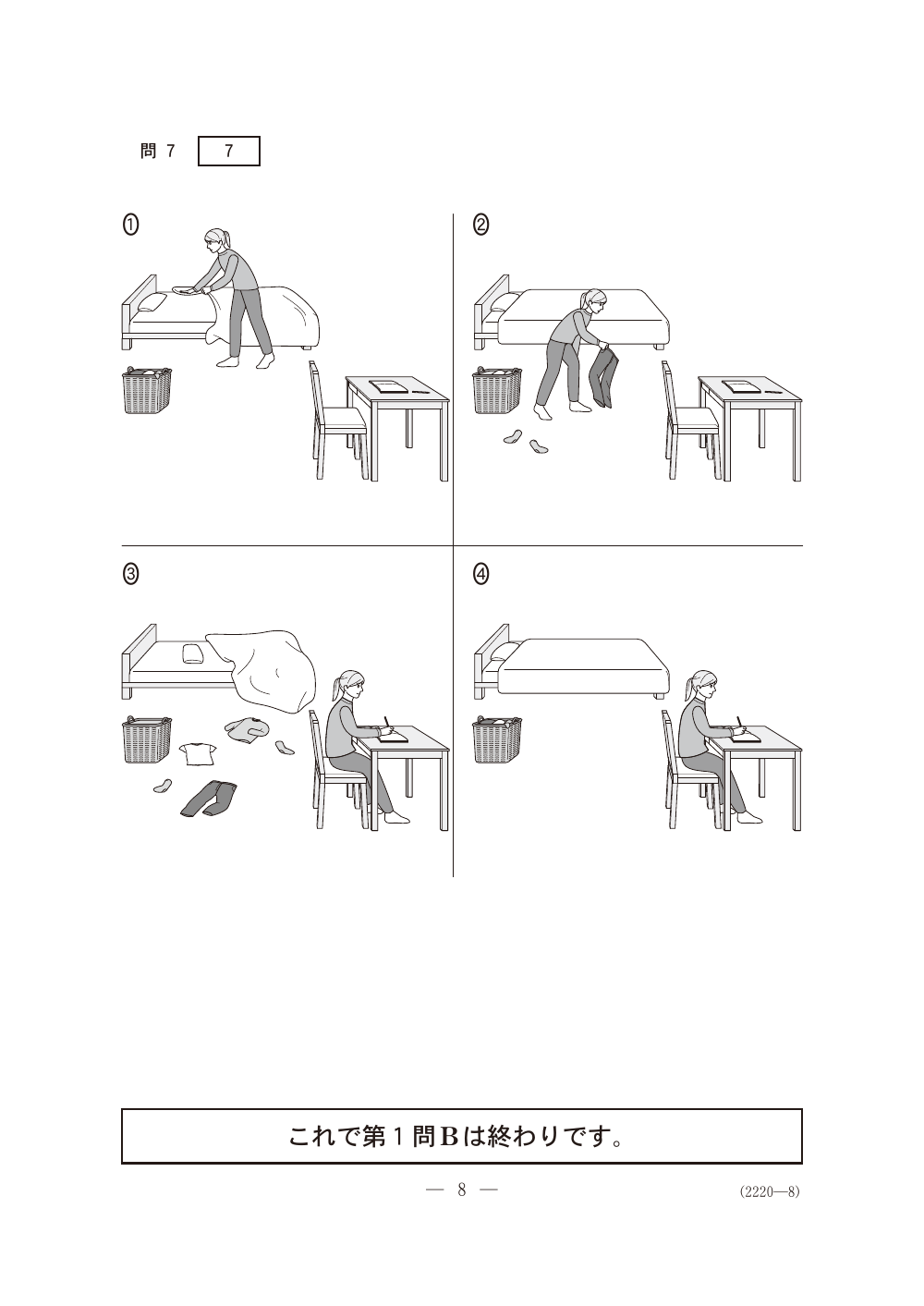
スクリプト・和訳・解説を見る
スクリプト
M: Emma has finished picking up her clothes and making her bed. Now she has begun doing her homework.エマは服を拾い上げてベッドを整え終えました。今は宿題をやり始めたところです。
解説
正解は④。エマは服の片付けとベッドを整えることを終え,今は宿題を始めたところだから。決め手は「has finished picking up her clothes and making her bed」と「has begun doing her homework」の対比で,部屋が片付いた状態で机に向かっている絵を選ぶ。服が散らかっている絵やベッドが乱れたままの絵は,finished(〜し終えた)を聞き逃した場合のひっかけ。宿題を終えて遊んでいる絵なら has finished doing her homework となるはずで誤り。コツ: finish -ing / begin -ingに注目し,「完了した動作」と「今進行中の動作」を絵の中で区別しよう。
第2問
対話の場面が日本語で書かれている。対話とそれについての問いを聞き,その答えとして最も適切なものを,四つの選択肢(①〜④)のうちから一つずつ選ぶ。音声は2回流れる。
問8
状況: 妹と兄が,話をしています。
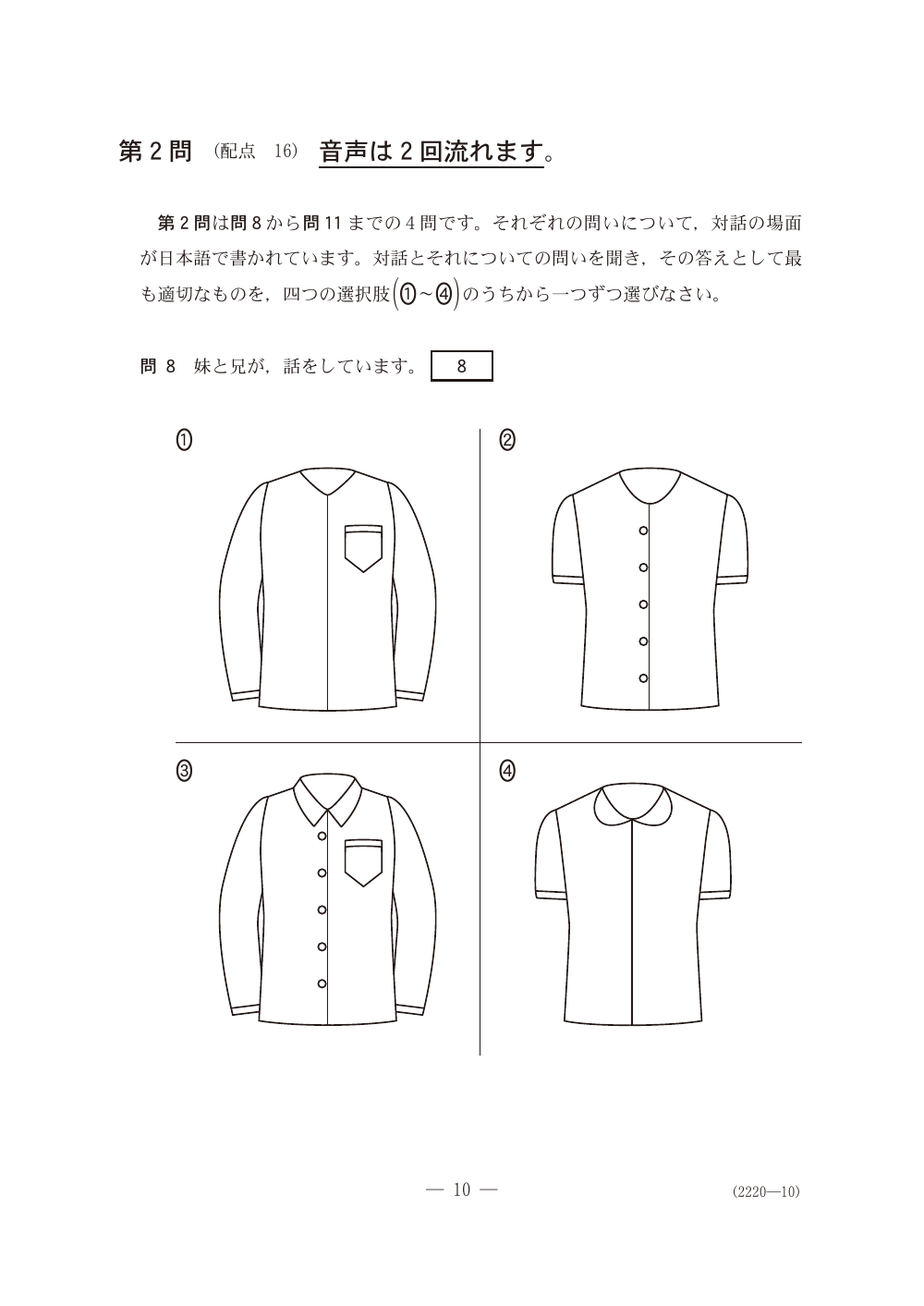
スクリプト・和訳・解説を見る
スクリプト
W: Which shirt goes well with my suit?どのシャツが私のスーツに合うかしら?
M: You're going to a job interview. Choose one with a collar.就職の面接に行くんだろ。襟のあるものを選びなよ。
W: You're right. How about this one with the pocket?そうね。このポケット付きのはどう?
M: That looks great.それはいいね。
Question: Which shirt will the woman wear?女性はどのシャツを着ますか。
解説
正解は③。就職面接向けに襟のあるシャツを勧められ,女性がその中からポケット付きのものを選んだから。決め手は男性の「Choose one with a collar.」と,女性の「How about this one with the pocket?」に男性が「That looks great.」と同意した流れで,襟とポケットの両方があるシャツに決まる。襟だけ,またはポケットだけのシャツは条件の一方しか満たさないひっかけ。コツ: 絵の選択問題では条件が複数回に分けて追加されるので,collar(襟)→pocket(ポケット)と出てきた特徴を順にメモし,すべて満たす絵を選ぼう。
問9
状況: 運動会で100 m走が始まります。
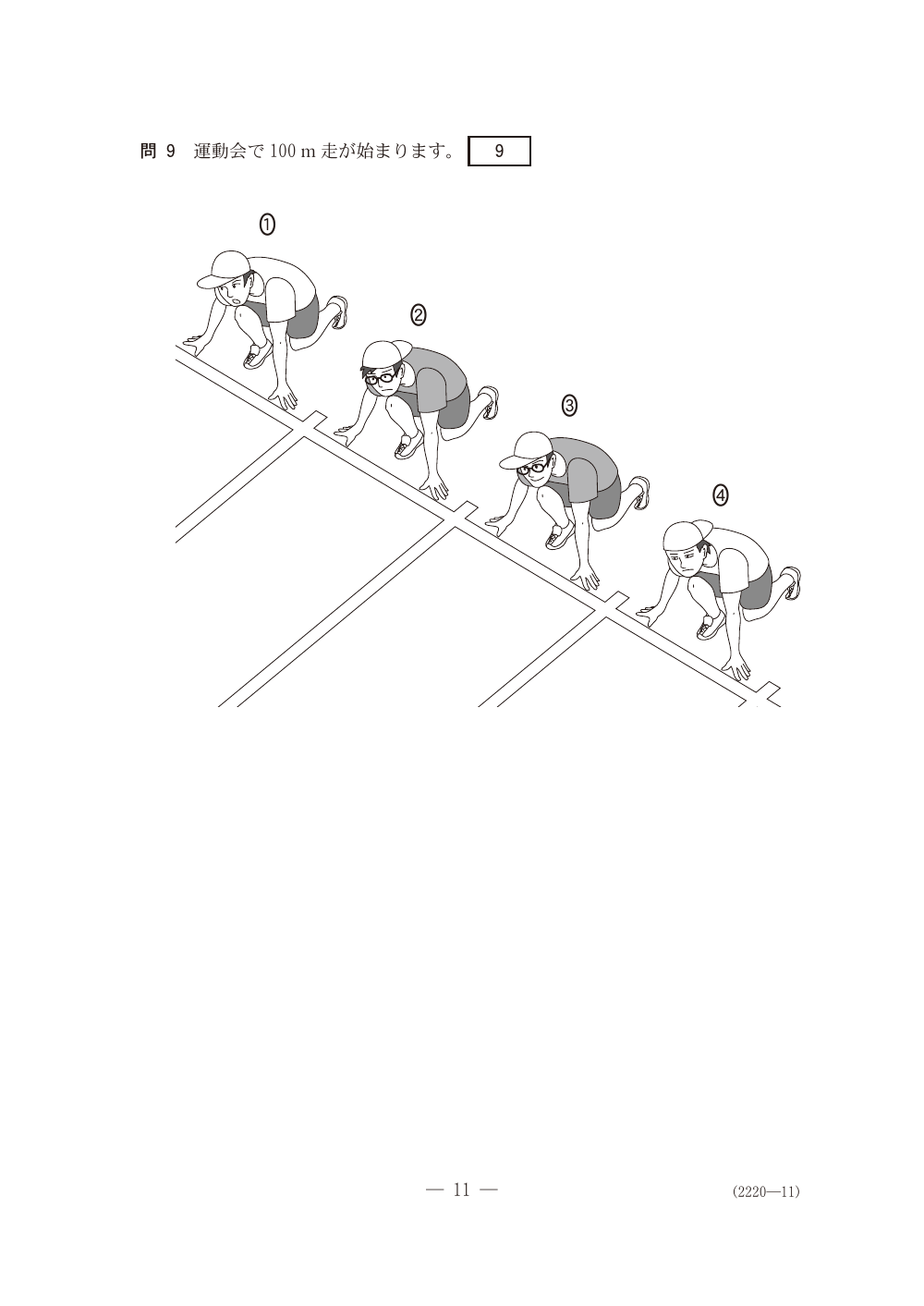
スクリプト・和訳・解説を見る
スクリプト
M: So, who do you think will win the race?それで,レースは誰が勝つと思う?
W: The boy wearing his cap backwards.帽子を後ろ向きにかぶっている男の子よ。
M: You mean the one with glasses?眼鏡をかけている子のこと?
W: No. The boy wearing a white T-shirt.いいえ。白いTシャツを着ている男の子よ。
Question: Who does the woman think will win?女性は誰が勝つと思っていますか。
解説
正解は④。女性が勝つと思っているのは,帽子を後ろ向きにかぶり,眼鏡をかけていない,白いTシャツの男の子だから。決め手は「The boy wearing his cap backwards.」と,「You mean the one with glasses?」への「No. The boy wearing a white T-shirt.」という答えの組み合わせ。眼鏡をかけた子は男性の推測がNoで否定されているのでひっかけ。帽子を前向きにかぶった子はbackwards(後ろ向きに)という条件に合わない。コツ: 人物を特定する問題では後半の訂正・追加情報で絞り込まれるので,No.の直後に出てくる特徴を最優先で聞き取ろう。
問10
状況: 友達のYukiについて話をしています。
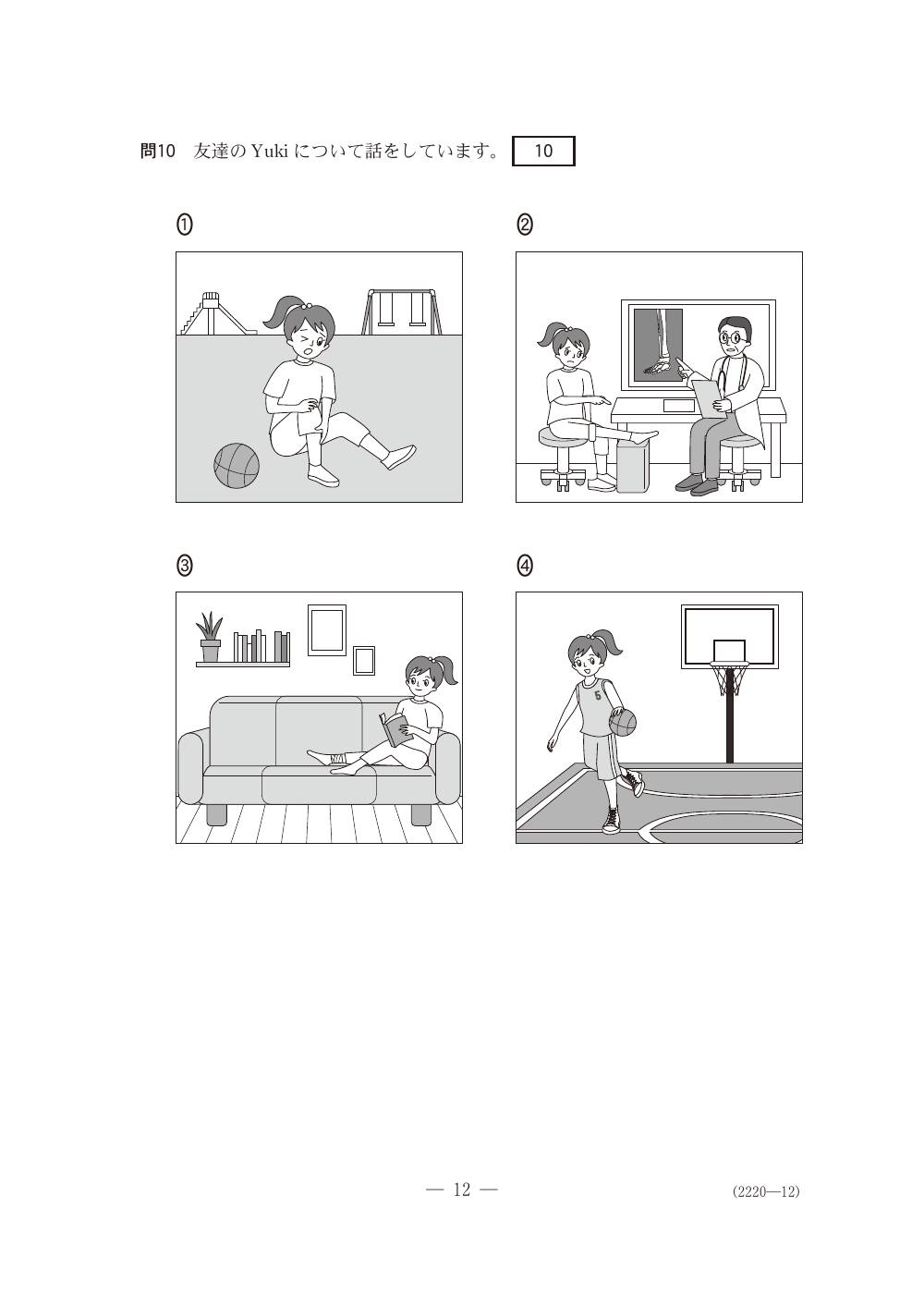
スクリプト・和訳・解説を見る
スクリプト
W: Yuki hurt her leg playing basketball in the park yesterday.ユキが昨日,公園でバスケットボールをしていて脚をけがしたの。
M: Did she go to the doctor?医者には行ったの?
W: No. She's just resting at home.いいえ。家で休んでいるだけよ。
M: So, I guess she won't be at practice today.じゃあ,今日の練習には来ないだろうね。
Question: What is Yuki doing now?ユキは今,何をしていますか。
解説
正解は③。ユキは医者には行かず,家で休んでいるだけだと述べているから。決め手は「No. She's just resting at home.」で,質問のWhat is Yuki doing now?(今何をしているか)への直接の答えになる。バスケットボールをしている絵は「hurt her leg playing basketball ... yesterday」という昨日の場面を使ったひっかけ。診察を受けている絵は「Did she go to the doctor?」がNoで否定されているので誤りで,練習に参加する絵も「she won't be at practice today」と矛盾する。コツ: 質問がnow(今)を尋ねるときは,過去の出来事や否定された行動の絵を消去し,現在進行形で語られた内容だけを残そう。
問11
状況: 道に迷った友達と電話で話をしています。
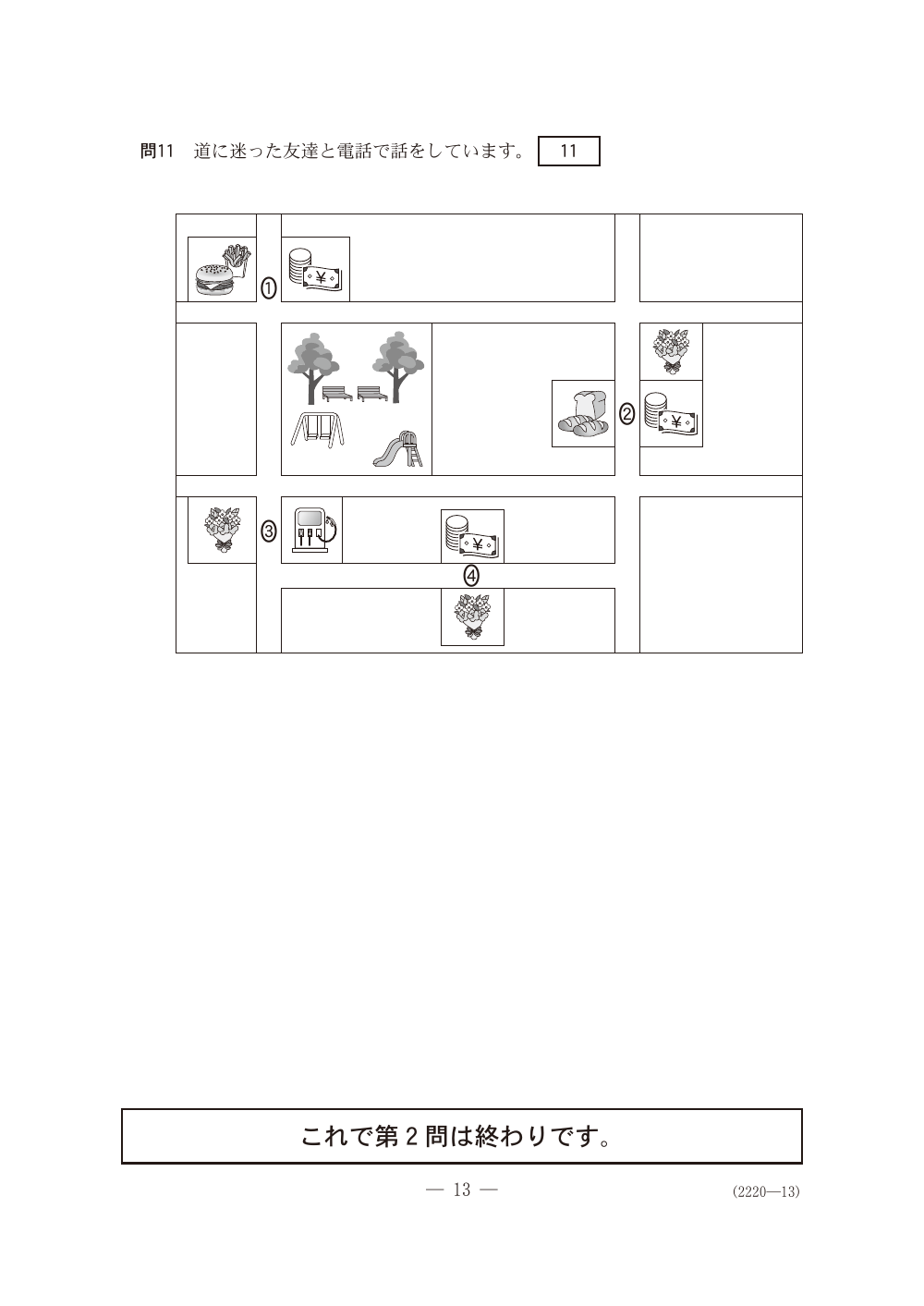
スクリプト・和訳・解説を見る
スクリプト
W: What can you see there?そこから何が見える?
M: Well, there's a bank.ええと,銀行があるよ。
W: Is there a bakery across from the bank?銀行の向かいにパン屋はある?
M: No, I don't see one, but there is a flower shop.いや,見当たらないな。でも花屋はあるよ。
Question: Where is the man standing?男性はどこに立っていますか。
解説
正解は④。男性のいる場所からは銀行が見え,その銀行の向かいにはパン屋ではなく花屋があるから。決め手は「Is there a bakery across from the bank?」への「No, I don't see one, but there is a flower shop.」という答えで,「銀行の向かいに花屋がある」地点が男性の現在地になる。銀行の向かいにパン屋がある地点は,Noで否定された配置なのでひっかけ。コツ: 地図問題ではacross from(〜の向かい)などの位置表現を聞いたら,Yes / Noのどちらで答えられたかまでセットで確認し,否定された配置の場所を一つずつ消去していこう。
第3問
対話の場面が日本語で書かれている。対話を聞き,問いの答えとして最も適切なものを,四つの選択肢(①〜④)のうちから一つずつ選ぶ。問いの英文は冊子に書かれている。音声は1回流れる。
問12 Which item will the man buy?
状況: 女性と男性が,雨具について話をしています。
スクリプト・和訳・解説を見る
スクリプト
W: It's starting to rain. Did you bring an umbrella or a raincoat?雨が降ってきたわ。傘かレインコートは持ってきた?
M: No, but I need to buy a new raincoat anyway. Mine's torn.いや。でもどのみち新しいレインコートを買わないといけないんだ。僕のは破れているから。
W: Look, there are some colorful ones in that store there.見て,あそこのお店にカラフルなものがいくつかあるわよ。
M: They're so bright!ずいぶん派手だね!
W: Well, they've got black ones, too.まあ,黒いものも置いてあるわよ。
M: OK. I'll buy one of those.よし,そのうちの一つを買うことにするよ。
解説
正解は①。男性は破れたレインコートを買い替える必要があり,派手な色ではなく黒いものを選んだから。決め手は「I need to buy a new raincoat anyway. Mine's torn.」と,「they've got black ones, too」を受けた「OK. I'll buy one of those.」で,those=black ones(黒いレインコート)を指す。②・④の傘は雨の場面から連想させるひっかけで,買う物はあくまでレインコート。③のカラフルなものは「They're so bright!(派手すぎる)」と男性が敬遠している。コツ: 代名詞ones / thoseが直前のどの名詞を指すかを追いかけることが,買う物を特定する決め手になる。
問13 What does the puppy usually do?
状況: 友人同士が,ペットの子犬について話をしています。
スクリプト・和訳・解説を見る
スクリプト
M: How's your puppy? Are you used to having a pet?子犬はどう?ペットを飼うのには慣れた?
W: Well, I feed him twice a day but he's always hungry. Also, I'm trying to teach him to sit and stay but he's so playful.そうね,1日2回えさをあげているんだけど,いつもおなかをすかせているの。それに「おすわり」と「待て」を教えようとしているんだけど,とても遊び好きで。
M: Isn't that a lot of work?それって大変じゃない?
W: It isn't easy, but I really enjoy it.楽ではないけど,本当に楽しんでいるわ。
解説
正解は②。子犬はしつけがうまくいかないほど遊び好きだと述べられているから。決め手は「I'm trying to teach him to sit and stay but he's so playful.」で,playful(遊び好きな)が②のHe plays with his owner.の言い換えになる。①は「I feed him twice a day(1日2回えさをやる)」と矛盾する。④はsit and stayという語から連想させるひっかけで,教えようとしている段階であり,まだ指示を待てないからこそso playfulと言っている。③のいつも眠っているは,always hungryで遊び好きという様子と合わない。コツ: butの後には話し手が本当に伝えたい情報が来るので,逆接の後ろを最重要ポイントとして聞き取ろう。
問14 What will happen next?
状況: 男性が,新居で生活を始めた女性と話をしています。
スクリプト・和訳・解説を見る
スクリプト
M: How's your new house?新しい家はどう?
W: Wonderful! My kitchen is so clean. I'm not good at cooking though.素晴らしいわ!台所がとてもきれいなの。私は料理が得意ではないけれど。
M: Really? I can show you how to make pizza.本当?ピザの作り方を教えてあげられるよ。
W: Great!うれしい!
M: We can make a Hawaiian pizza by adding pineapple.パイナップルを加えてハワイアンピザを作れるよ。
W: Oh, I like pineapple, but not on pizza.ああ,パイナップルは好きだけど,ピザにのせるのはいやなの。
M: OK, we don't have to add it.わかった,入れなくていいよ。
解説
正解は③。料理が苦手な女性に男性がピザの作り方を教えると申し出て,女性がそれを喜んで受け入れたから。決め手は「I can show you how to make pizza.」→「Great!」の流れで,show you how to ~(〜のやり方を教える)が③のlearn how to make pizza(作り方を教わる)の言い換えになる。④は教える側と教わる側を入れ替えたひっかけで,女性自身が「I'm not good at cooking」と言っている。②は「OK, we don't have to add it.(入れなくていい)」と決まったので誤り。①の台所の掃除は,My kitchen is so clean(すでにきれい)という発言を利用したひっかけ。コツ: 申し出(I can ~)とその返事(Great!など)のセットで次の行動が決まることが多いので,提案への応答を必ず確認しよう。
問15 What will the mother do?
状況: 親子が,学園祭について話をしています。
スクリプト・和訳・解説を見る
スクリプト
M: Mom, are you coming to my dance performance at the festival this Friday?お母さん,今週の金曜日の学園祭での僕のダンス発表に来てくれる?
W: I'm sorry. I have a business trip this week. Don't you remember?ごめんなさい。今週は出張なの。覚えてない?
M: Oh, right! I forgot.ああ,そうだった!忘れてたよ。
W: But your uncle will take a video. We can all watch it next week.でも,おじさんがビデオを撮ってくれるわ。来週みんなで見られるわよ。
M: Good! I hope everyone enjoys it.よかった!みんなが楽しんでくれるといいな。
解説
正解は④。母親は出張で学園祭には行けないが,おじが撮るビデオを来週みんなで見ると言っているから。決め手は「your uncle will take a video. We can all watch it next week.」で,金曜日の学園祭が終わった後の来週にビデオを見るという④の内容と一致する。②は来週にするのは「学園祭に行くこと」ではなく「ビデオを見ること」なので,行動をすり替えたひっかけ。③は出張後に参加するとは言っておらず,参加自体をあきらめている。①はビデオを撮るのがおじであって,母親が一緒に参加するわけではない。コツ: 「誰が・いつ・何をするか」を人物ごとに整理し,next weekのような時の表現がどの行動を指すかを取り違えないようにしよう。
問16 What are they going to do?
状況: 女性が,男性を散歩に誘っています。
スクリプト・和訳・解説を見る
スクリプト
W: I'm going for a walk. Do you want to come along?散歩に行くんだけど。一緒に来る?
M: Sure. Where are we going?いいよ。どこへ行くの?
W: To the river. Let's walk through the park on the way.川までよ。途中で公園の中を歩いて行きましょう。
M: How about lunch?昼食はどうする?
W: There's a nice café on the other side of the park. Let's eat there before we get to the river.公園の反対側に素敵なカフェがあるの。川に着く前にそこで食べましょう。
M: Great!いいね!
解説
正解は③。公園を通り抜けた先にあるカフェで,川に着く前に昼食をとる予定だから。決め手は「There's a nice café on the other side of the park. Let's eat there before we get to the river.」で,「公園の反対側のカフェで食べる」=「公園を通り抜けた後で昼食」という③の言い換えになる。④は順序が逆で,昼食の後に公園を歩くわけではない。②は「Let's walk through the park on the way(途中で公園を通る)」と矛盾する。①は食べる場所がカフェであって川ではない。コツ: before / afterと場所を表す前置詞句を組み合わせ,「公園→カフェ(昼食)→川」のように行動を時系列に並べ直しながら聞こう。
問17 What does the man decide to do?
状況: 夫婦が,ドラマを見ながら話をしています。
スクリプト・和訳・解説を見る
スクリプト
W: Let's watch another episode of the series.このシリーズをもう1話見ましょうよ。
M: Well, I'm supposed to meet my friends later.うーん,この後友達と会うことになっているんだ。
W: The episode is less than an hour, so maybe you have time!1話は1時間もないから,時間はあるんじゃない!
M: Hmm, there's a bus leaving in 30 minutes, and another in an hour. I'd rather not be rushed, so I'd better take the earlier one.うーん,30分後に出るバスと,1時間後のバスがあるんだ。慌てたくないから,早い方に乗った方がいいな。
解説
正解は②。男性は慌てたくないので,30分後に出る早い方のバスに乗ると決めたから。決め手は「I'd rather not be rushed, so I'd better take the earlier one.」で,the earlier one=30分後のバスに乗る,つまりまもなく出発して友人に会いに行くという②の言い換えになる。④は「1話は1時間未満だから時間がある」という女性の説得を利用したひっかけだが,男性はその提案を受け入れていない。③は「後のバス」ではなく「早いバス」を選んだので逆。①の約束のキャンセルは本文で一度も述べられていない。コツ: I'd rather / I'd betterの後には話し手の最終決定が来るので,迷いの表現(Hmm)の後の結論部分を聞き逃さないようにしよう。
第4問A
話を聞き,それぞれの問いの答えとして最も適切なものを選択肢から選ぶ。問題文と図表を読む時間が与えられた後,音声が1回流れる。問18〜21は四つすべて正解の場合のみ点が与えられる。
問18 説明を聞き,その内容を表した四つのイラスト(①〜④)を,今回受診する順番に並べなさい(1番目)。
状況: 大学で,健康診断について看護師から説明を受けています。
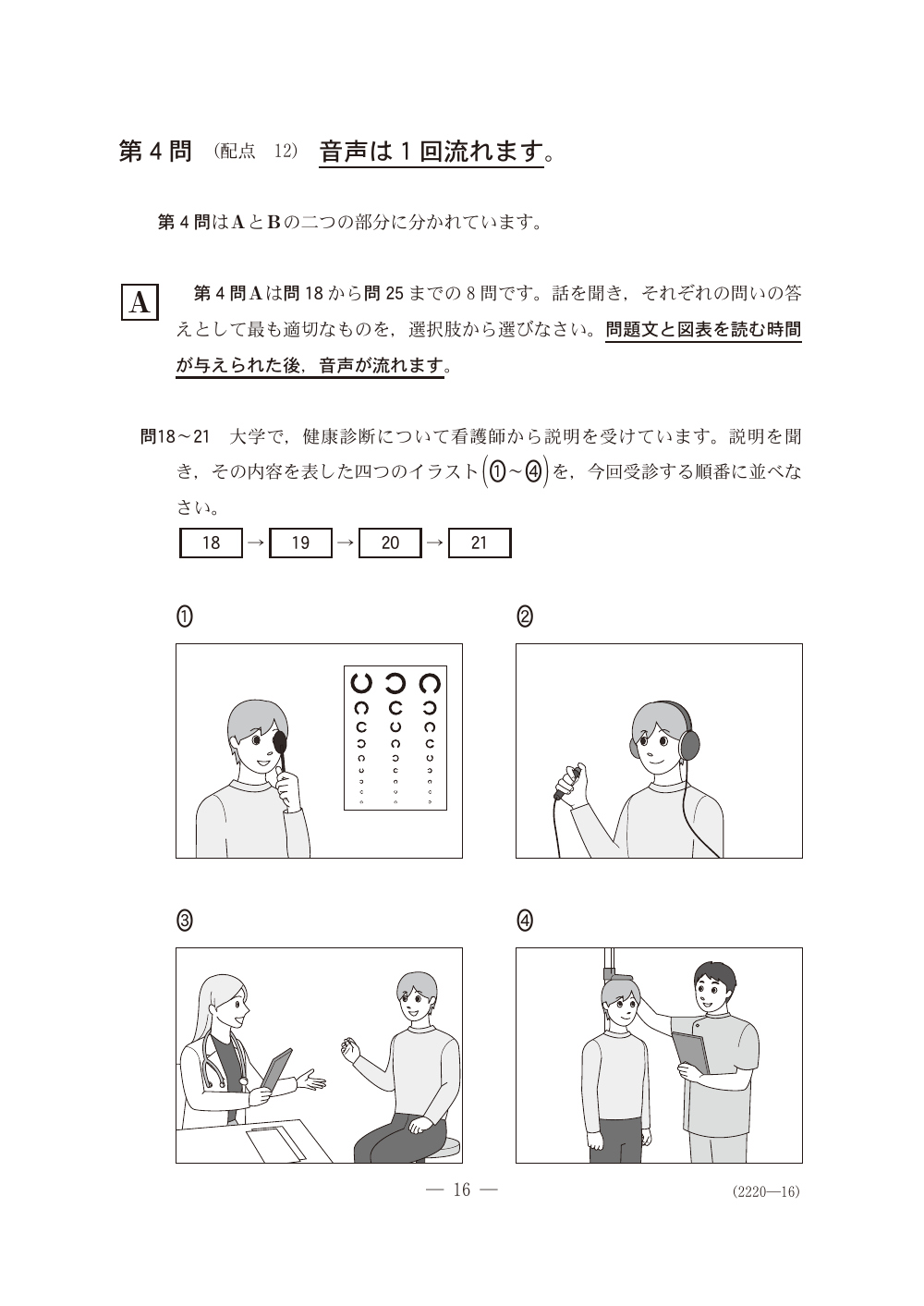
スクリプト・和訳・解説を見る
スクリプト
I'll now explain the order you'll follow for your annual medical check-up today.これから,本日の年に一度の健康診断で皆さんが受診する順番を説明します。
Usually, everyone begins with a vision test, but that section is very busy right now, so please go to the hearing test first.通常は全員が視力検査から始めますが,その区画は今とても混み合っているので,まず聴力検査に行ってください。
Then, get your eyes tested.その後で,視力を検査してもらってください。
After that, and this is also different from usual, please go to the next room, where the doctor will check your overall health.その次に,これもいつもとは違いますが,隣の部屋へ行ってください。そこで医師が全身の健康状態を診察します。
Finally, you will get your height and weight measured.最後に,身長と体重を測定してもらいます。
解説
正解は②(聴力検査)。今日は通常と違い,最初に聴力検査へ行くよう指示されているから。決め手は「Usually, everyone begins with a vision test, but that section is very busy right now, so please go to the hearing test first.」で,butの後のgo to the hearing test firstが1番目の指示になる。冒頭のvision testは「いつもなら最初」という情報にすぎず,①(視力検査)を選ばせるひっかけ。全体の順番は聴力②→視力①→医師の診察③→身長・体重④。コツ: Usually ~, but ...の形では,butの後こそが「今日の実際の手順」なので,最初に聞こえた語に飛びつかないようにしよう。(問18〜21は四つすべて正解の場合のみ4点)
問19 説明を聞き,その内容を表した四つのイラスト(①〜④)を,今回受診する順番に並べなさい(2番目)。
状況: 大学で,健康診断について看護師から説明を受けています。
スクリプト・和訳・解説を見る
スクリプト
I'll now explain the order you'll follow for your annual medical check-up today.これから,本日の年に一度の健康診断で皆さんが受診する順番を説明します。
Usually, everyone begins with a vision test, but that section is very busy right now, so please go to the hearing test first.通常は全員が視力検査から始めますが,その区画は今とても混み合っているので,まず聴力検査に行ってください。
Then, get your eyes tested.その後で,視力を検査してもらってください。
After that, and this is also different from usual, please go to the next room, where the doctor will check your overall health.その次に,これもいつもとは違いますが,隣の部屋へ行ってください。そこで医師が全身の健康状態を診察します。
Finally, you will get your height and weight measured.最後に,身長と体重を測定してもらいます。
解説
正解は①(視力検査)。聴力検査の次に目の検査を受けるよう指示されているから。決め手は「Then, get your eyes tested.」で,get your eyes tested(目を検査してもらう)=vision test(視力検査)の言い換えになる。冒頭で「いつもは視力検査が最初」と言われるため1番目に置きたくなるが,今日は2番目なのがポイント。全体の順番は聴力②→視力①→医師の診察③→身長・体重④。コツ: Then / After that / Finallyといった順序を示すつなぎ語をメモの軸にして,聞こえた順にイラスト番号を書き込んでいこう。(問18〜21は四つすべて正解の場合のみ4点)
問20 説明を聞き,その内容を表した四つのイラスト(①〜④)を,今回受診する順番に並べなさい(3番目)。
状況: 大学で,健康診断について看護師から説明を受けています。
スクリプト・和訳・解説を見る
スクリプト
I'll now explain the order you'll follow for your annual medical check-up today.これから,本日の年に一度の健康診断で皆さんが受診する順番を説明します。
Usually, everyone begins with a vision test, but that section is very busy right now, so please go to the hearing test first.通常は全員が視力検査から始めますが,その区画は今とても混み合っているので,まず聴力検査に行ってください。
Then, get your eyes tested.その後で,視力を検査してもらってください。
After that, and this is also different from usual, please go to the next room, where the doctor will check your overall health.その次に,これもいつもとは違いますが,隣の部屋へ行ってください。そこで医師が全身の健康状態を診察します。
Finally, you will get your height and weight measured.最後に,身長と体重を測定してもらいます。
解説
正解は③(医師の診察)。視力検査の後は隣の部屋で医師が全身の健康状態を診ると述べているから。決め手は「After that, and this is also different from usual, please go to the next room, where the doctor will check your overall health.」で,the doctor will check your overall healthが医師の診察のイラストに対応する。「this is also different from usual(これもいつもと違う)」という挿入があるため,指示の本体を聞き逃しやすい。全体の順番は聴力②→視力①→医師の診察③→身長・体重④。コツ: 挿入句に惑わされず,please go to ~ / where ~の骨組みだけを追って3番目の行き先を確定させよう。(問18〜21は四つすべて正解の場合のみ4点)
問21 説明を聞き,その内容を表した四つのイラスト(①〜④)を,今回受診する順番に並べなさい(4番目)。
状況: 大学で,健康診断について看護師から説明を受けています。
スクリプト・和訳・解説を見る
スクリプト
I'll now explain the order you'll follow for your annual medical check-up today.これから,本日の年に一度の健康診断で皆さんが受診する順番を説明します。
Usually, everyone begins with a vision test, but that section is very busy right now, so please go to the hearing test first.通常は全員が視力検査から始めますが,その区画は今とても混み合っているので,まず聴力検査に行ってください。
Then, get your eyes tested.その後で,視力を検査してもらってください。
After that, and this is also different from usual, please go to the next room, where the doctor will check your overall health.その次に,これもいつもとは違いますが,隣の部屋へ行ってください。そこで医師が全身の健康状態を診察します。
Finally, you will get your height and weight measured.最後に,身長と体重を測定してもらいます。
解説
正解は④(身長・体重測定)。最後に身長と体重を測ってもらうと述べているから。決め手は「Finally, you will get your height and weight measured.」で,Finally(最後に)が4番目の合図となり,height and weight(身長と体重)の測定のイラストが対応する。get + 物 + 過去分詞(〜してもらう)の形なので,自分で測るのではなく測定してもらう場面である点にも注意。全体の順番は聴力②→視力①→医師の診察③→身長・体重④。コツ: First / Then / After that / Finallyの流れを聞いたら,Finallyの後は必ず最後の項目だと確定させ,先にマークしてしまおう。(問18〜21は四つすべて正解の場合のみ4点)
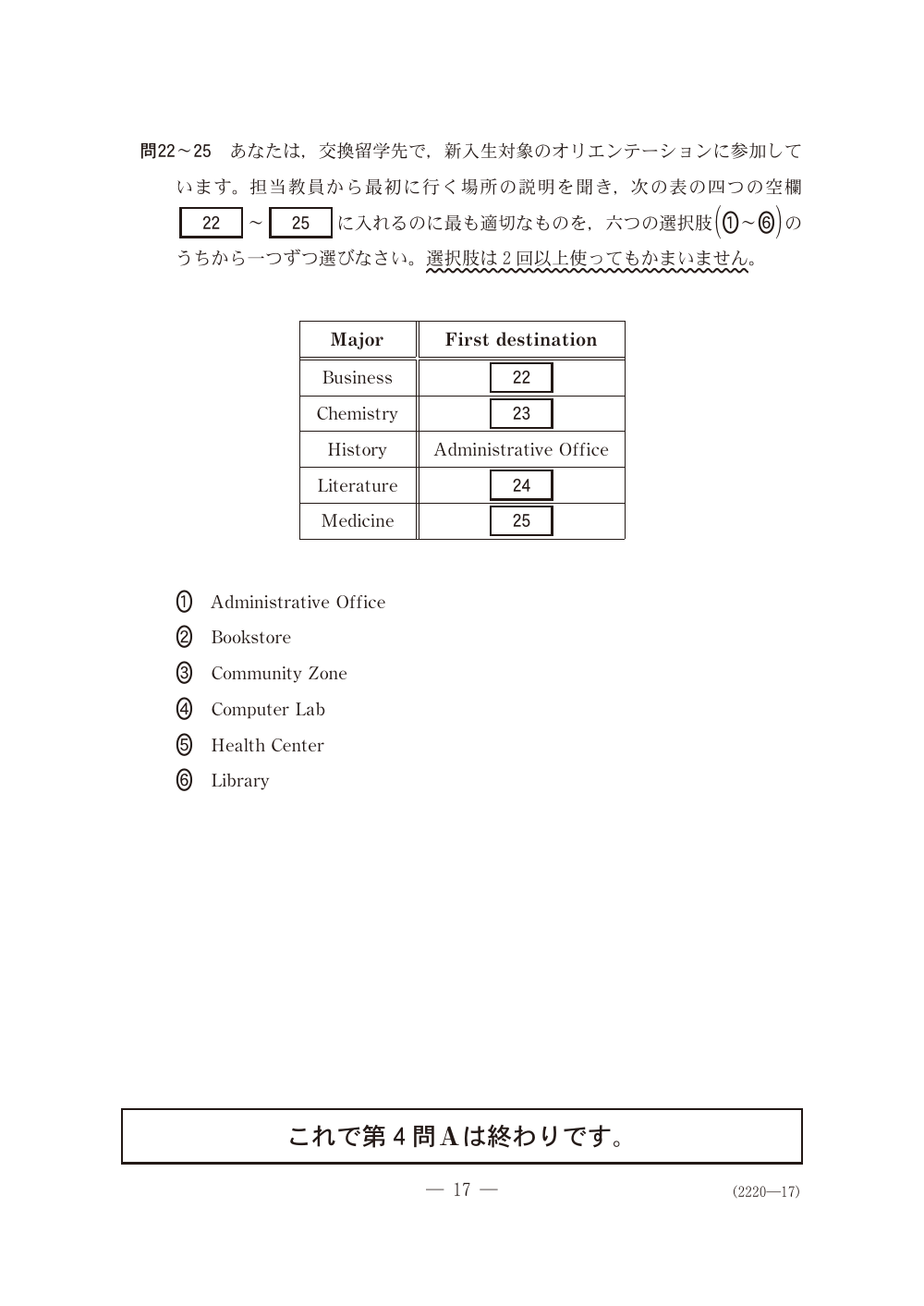
問22 担当教員の説明を聞き,表の空欄(Business の First destination)に入れるのに最も適切なものを,六つの選択肢(①〜⑥)のうちから一つ選びなさい。選択肢は2回以上使ってもかまいません。
状況: あなたは,交換留学先で,新入生対象のオリエンテーションに参加しています。
スクリプト・和訳・解説を見る
スクリプト
Attention please!お知らせします!
All students majoring in literature and history must go to the administrative office to learn about campus rules and regulations.文学と歴史学を専攻するすべての学生は,キャンパスの規則について学ぶために事務室へ行かなければなりません。
Chemistry majors will hear from some of our clubs and sports representatives at the Community Zone before going to the bookstore.化学専攻の学生は,書店へ行く前に,コミュニティゾーンでクラブやスポーツの代表者の話を聞きます。
Medical students are to go directly to the library to learn about our new medical database.医学専攻の学生は,新しい医療データベースについて学ぶために,図書館へ直接行くことになっています。
Finally, students majoring in business should go to the computer lab and then visit the health center.最後に,経営学を専攻する学生は,コンピュータ室へ行き,その後で保健センターを訪れてください。
Any questions?何か質問はありますか。
解説
正解は④(Computer Lab)。経営学専攻の学生は最初にコンピュータ室へ行くよう指示されているから。決め手は「students majoring in business should go to the computer lab and then visit the health center」で,and then(それから)の前にあるcomputer labが最初の行き先になる。⑤のHealth Centerは2番目に行く場所であり,文の後半だけを聞くと選んでしまうひっかけ。コツ: 「最初に行く場所」を問う表の問題では,A and then B / before Bのような順序表現から,どちらが先かを瞬時に判断してメモしよう。
問23 担当教員の説明を聞き,表の空欄(Chemistry の First destination)に入れるのに最も適切なものを,六つの選択肢(①〜⑥)のうちから一つ選びなさい。選択肢は2回以上使ってもかまいません。
状況: あなたは,交換留学先で,新入生対象のオリエンテーションに参加しています。
スクリプト・和訳・解説を見る
スクリプト
Attention please!お知らせします!
All students majoring in literature and history must go to the administrative office to learn about campus rules and regulations.文学と歴史学を専攻するすべての学生は,キャンパスの規則について学ぶために事務室へ行かなければなりません。
Chemistry majors will hear from some of our clubs and sports representatives at the Community Zone before going to the bookstore.化学専攻の学生は,書店へ行く前に,コミュニティゾーンでクラブやスポーツの代表者の話を聞きます。
Medical students are to go directly to the library to learn about our new medical database.医学専攻の学生は,新しい医療データベースについて学ぶために,図書館へ直接行くことになっています。
Finally, students majoring in business should go to the computer lab and then visit the health center.最後に,経営学を専攻する学生は,コンピュータ室へ行き,その後で保健センターを訪れてください。
Any questions?何か質問はありますか。
解説
正解は③(Community Zone)。化学専攻の学生は書店へ行く前にコミュニティゾーンで話を聞くから。決め手は「Chemistry majors will hear from some of our clubs and sports representatives at the Community Zone before going to the bookstore」で,before going to the bookstore(書店へ行く前に)から,先に行くのはCommunity Zoneだとわかる。②のBookstoreは2番目の行き先を答えさせるひっかけ。コツ: before -ingは「〜する前に」なので,主節で述べられた場所の方が時系列では先になることに注意しよう。
問24 担当教員の説明を聞き,表の空欄(Literature の First destination)に入れるのに最も適切なものを,六つの選択肢(①〜⑥)のうちから一つ選びなさい。選択肢は2回以上使ってもかまいません。
状況: あなたは,交換留学先で,新入生対象のオリエンテーションに参加しています。
スクリプト・和訳・解説を見る
スクリプト
Attention please!お知らせします!
All students majoring in literature and history must go to the administrative office to learn about campus rules and regulations.文学と歴史学を専攻するすべての学生は,キャンパスの規則について学ぶために事務室へ行かなければなりません。
Chemistry majors will hear from some of our clubs and sports representatives at the Community Zone before going to the bookstore.化学専攻の学生は,書店へ行く前に,コミュニティゾーンでクラブやスポーツの代表者の話を聞きます。
Medical students are to go directly to the library to learn about our new medical database.医学専攻の学生は,新しい医療データベースについて学ぶために,図書館へ直接行くことになっています。
Finally, students majoring in business should go to the computer lab and then visit the health center.最後に,経営学を専攻する学生は,コンピュータ室へ行き,その後で保健センターを訪れてください。
Any questions?何か質問はありますか。
解説
正解は①(Administrative Office)。文学専攻の学生は歴史学専攻とともに事務室へ行くよう指示されているから。決め手は「All students majoring in literature and history must go to the administrative office」で,literatureとhistoryがandで並列され,同じ指示が両方に当てはまる。表ではHistoryの行がすでにAdministrative Officeと埋まっており,これが大きなヒントになる。同じ選択肢を使うことをためらって別の場所を選ばないように注意(選択肢は2回以上使える)。コツ: A and Bの並列を聞いたら,既に埋まっている行と同じ答えになる可能性を恐れず選ぼう。
問25 担当教員の説明を聞き,表の空欄(Medicine の First destination)に入れるのに最も適切なものを,六つの選択肢(①〜⑥)のうちから一つ選びなさい。選択肢は2回以上使ってもかまいません。
状況: あなたは,交換留学先で,新入生対象のオリエンテーションに参加しています。
スクリプト・和訳・解説を見る
スクリプト
Attention please!お知らせします!
All students majoring in literature and history must go to the administrative office to learn about campus rules and regulations.文学と歴史学を専攻するすべての学生は,キャンパスの規則について学ぶために事務室へ行かなければなりません。
Chemistry majors will hear from some of our clubs and sports representatives at the Community Zone before going to the bookstore.化学専攻の学生は,書店へ行く前に,コミュニティゾーンでクラブやスポーツの代表者の話を聞きます。
Medical students are to go directly to the library to learn about our new medical database.医学専攻の学生は,新しい医療データベースについて学ぶために,図書館へ直接行くことになっています。
Finally, students majoring in business should go to the computer lab and then visit the health center.最後に,経営学を専攻する学生は,コンピュータ室へ行き,その後で保健センターを訪れてください。
Any questions?何か質問はありますか。
解説
正解は⑥(Library)。医学専攻の学生は図書館へ直接行くよう指示されているから。決め手は「Medical students are to go directly to the library to learn about our new medical database」で,directly(直接)から,寄り道なしに図書館が最初の行き先だとわかる。medicalという語の響きから⑤のHealth Center(保健センター)を連想させるのがひっかけで,データベースについて学ぶ場所は図書館。コツ: be to do は指示・予定を表す表現で,アナウンスでは「〜することになっている・〜してください」の意味。目的を表すto learn about ~と行き先を混同しないようにしよう。
第4問B
四人の話を聞き,示された条件に最も合うものを,四つの選択肢(①〜④)のうちから一つ選ぶ。状況と条件を読む時間が与えられた後,音声が1回流れる。
問26 The [ 26 ] is the location you are most likely to choose.
状況: あなたは,ボランティア活動の中から,参加するものを一つ決めるために,四人の上級生から話を聞いています。条件:A.毎回午後3時までに終わること。B.平日のみの参加でよいこと。C.屋内のみで行われること。
スクリプト・和訳・解説を見る
スクリプト
① Volunteers who can work until 3 pm on Mondays and Thursdays are needed at the food bank.①フードバンクでは,月曜日と木曜日に午後3時まで働けるボランティアを必要としています。
The work isn't hard, but it's very important.仕事は大変ではありませんが,とても重要です。
It mostly includes dividing the food donations into individual packages.主に,寄付された食品を一人分ずつの包みに分ける作業です。
Volunteers hand out these packages to the people waiting in line outside.ボランティアは,外で列に並んで待っている人々にこの包みを手渡します。
② Volunteering at the kindergarten is fun.②幼稚園でのボランティアは楽しいですよ。
They're flexible about the days you want to work, and it's nice that the work is only in the morning.働きたい曜日については柔軟に対応してくれますし,仕事が午前中だけなのもいいところです。
The job includes reading stories, cleaning the classrooms, and playing with the children out in the playground.仕事には,お話の読み聞かせ,教室の掃除,そして外の園庭で子どもたちと遊ぶことが含まれます。
③ The library is a great place to volunteer.③図書館はボランティアをするのに素晴らしい場所です。
They want help with sorting books and doing some light cleaning.本の整理と軽い掃除の手伝いを求めています。
It's 3 days a week from Friday to Sunday, and the hours are very convenient, from 8 am to 3 pm.金曜日から日曜日までの週3日で,時間は午前8時から午後3時までととても都合がよいです。
④ The senior center always needs people.④高齢者センターは常に人手を必要としています。
They are looking for volunteers to help serve meals and chat with the elderly people in the common room.共用室で食事の配膳を手伝い,お年寄りとおしゃべりをするボランティアを探しています。
Volunteers can choose to work on weekdays or weekends and have the choice of either morning or evening shifts.ボランティアは平日か週末かを選ぶことができ,午前と夕方のどちらのシフトにするかも選べます。
解説
正解は④(senior center)。高齢者センターだけが三つの条件をすべて満たすから。決め手は「Volunteers can choose to work on weekdays or weekends and have the choice of either morning or evening shifts」と「serve meals and chat with the elderly people in the common room」で,平日+午前シフトを選べば毎回午後3時までに終わり(条件A・B),仕事場所も共用室で屋内のみ(条件C)となる。①のフードバンクは「hand out these packages to the people waiting in line outside」と屋外での作業があり条件Cを満たさない。②の幼稚園も「playing with the children out in the playground(外の園庭で遊ぶ)」があるため条件Cに反する。③の図書館は「from Friday to Sunday」と週末の参加が必要で条件Bに合わない。コツ: 条件マッチ問題は表にA・B・Cの○×を書き込みながら聞き,一つでも×がついた選択肢をその場で消去していこう。
第5問
最初に講義を聞き問27〜32に答え,次に講義の続きを聞き問33に答える。状況・ワークシート・図表を読む時間が与えられた後,音声は1回流れる。問28・29と問30・31は,それぞれ両方正解の場合のみ点が与えられる。
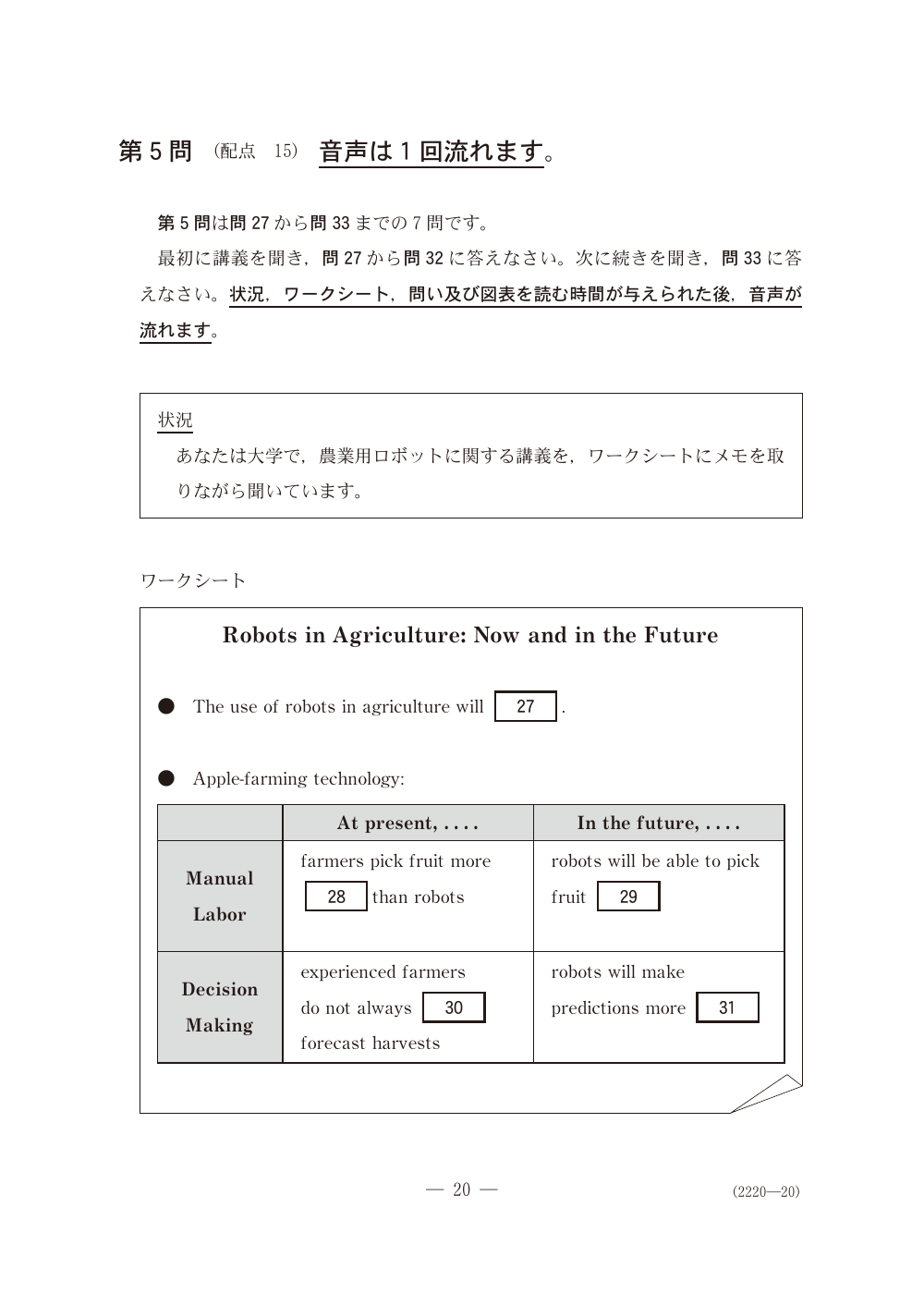
問27 ワークシートの空欄 27 に入れるのに最も適切なものを,四つの選択肢(①〜④)のうちから一つ選びなさい。
状況: あなたは大学で,農業用ロボットに関する講義を,ワークシートにメモを取りながら聞いています。
スクリプト・和訳・解説を見る
スクリプト
Today, we will learn about robots in agriculture.今日は,農業におけるロボットについて学びます。
Robots are already used for planting, harvesting, and other jobs.ロボットはすでに,植え付けや収穫,その他の作業に使われています。
Now, farm workers are retiring and there are not enough workers to take their place.現在,農場労働者が引退しつつあり,その後を継ぐ働き手が足りていません。
Robots have the potential to help with this labor shortage and improve agricultural production.ロボットには,この労働力不足を補い,農業生産を向上させる可能性があります。
Let's look at the apple industry and consider how robots can help with manual work and decision-making.リンゴ産業を取り上げて,ロボットが肉体労働と意思決定をどのように手助けできるかを考えてみましょう。
On apple farms in the U.S., both robots and humans do manual work.アメリカのリンゴ農場では,ロボットと人間の両方が肉体労働を行っています。
Now, robots are slower than humans at picking apples.現在のところ,リンゴを摘む速さではロボットは人間より遅いです。
However, in the future, advanced robots will be more effective because they will be able to keep working without a break, unlike humans.しかし将来は,高性能なロボットの方が効果的になるでしょう。人間と違って,休憩なしで働き続けることができるからです。
As technology improves, robots will better assist people in doing routine manual work like picking apples.技術が向上するにつれて,ロボットはリンゴ摘みのような定型的な肉体労働で,人間をよりうまく手助けするようになるでしょう。
Currently, humans rather than robots make decisions.現在,意思決定を行っているのはロボットではなく人間です。
For example, farmers do an amazing job of anticipating how many apples they can harvest each year.例えば,農家は毎年どれくらいのリンゴを収穫できるかを見事に予測します。
However, even growers with a lot of experience are not always accurate and this can cause financial loss.しかし,経験豊富な生産者でも常に正確とは限らず,これが金銭的な損失につながることがあります。
In the future, data-collecting robots and AI are expected to work together to make more precise predictions about apple harvesting.将来は,データを収集するロボットとAIが協力して,リンゴの収穫についてより正確な予測を行うことが期待されています。
Does this mean all work, including non-routine work, will be done by robots?これは,非定型の仕事も含めて,すべての仕事がロボットによって行われるようになるという意味でしょうか。
No, not at all.いいえ,まったくそうではありません。
Some non-routine decision-making work and some manual work will still be done by humans.一部の非定型の意思決定の仕事と一部の肉体労働は,今後も人間が行います。
For example, robots have difficulty picking apples from trees of different shapes and sizes.例えば,ロボットは形や大きさの異なる木からリンゴを摘むのが苦手です。
Humans will still need to manage the trees by deciding the best shapes for harvesting, and cut the trees by hand.人間は今後も,収穫に最適な樹形を決めて木を管理し,手作業で木を剪定する必要があるでしょう。
Our first team will talk about the connection between robots and different types of agricultural work.最初のチームには,ロボットとさまざまな種類の農作業との関係について話してもらいます。
Team 1, please start.チーム1,始めてください。
解説
正解は③。農業でのロボットの活用は働き手の不足を補うだろう,という講義の導入部の内容だから。決め手は「Robots have the potential to help with this labor shortage and improve agricultural production.」で,labor shortage(労働力不足)が③のthe lack of workersの言い換えになる。④のretirementは「farm workers are retiring(引退しつつある)」という現状説明の単語を利用したひっかけで,ロボットが早期退職をもたらすわけではない。①の年配の働き手を集める話は出てこず,②のplantingも冒頭で作業の例として挙がるだけ。コツ: ワークシートの冒頭の空欄は講義の導入部に対応することが多いので,potential to ~(〜する可能性)のような「これからの見通し」を示す表現の直後を狙って聞き取ろう。
問28 ワークシートの空欄 28 に入れるのに最も適切なものを,六つの選択肢(①〜⑥)のうちから一つ選びなさい。選択肢は2回以上使ってもかまいません。
状況: あなたは大学で,農業用ロボットに関する講義を,ワークシートにメモを取りながら聞いています。
スクリプト・和訳・解説を見る
スクリプト
Today, we will learn about robots in agriculture.今日は,農業におけるロボットについて学びます。
Robots are already used for planting, harvesting, and other jobs.ロボットはすでに,植え付けや収穫,その他の作業に使われています。
Now, farm workers are retiring and there are not enough workers to take their place.現在,農場労働者が引退しつつあり,その後を継ぐ働き手が足りていません。
Robots have the potential to help with this labor shortage and improve agricultural production.ロボットには,この労働力不足を補い,農業生産を向上させる可能性があります。
Let's look at the apple industry and consider how robots can help with manual work and decision-making.リンゴ産業を取り上げて,ロボットが肉体労働と意思決定をどのように手助けできるかを考えてみましょう。
On apple farms in the U.S., both robots and humans do manual work.アメリカのリンゴ農場では,ロボットと人間の両方が肉体労働を行っています。
Now, robots are slower than humans at picking apples.現在のところ,リンゴを摘む速さではロボットは人間より遅いです。
However, in the future, advanced robots will be more effective because they will be able to keep working without a break, unlike humans.しかし将来は,高性能なロボットの方が効果的になるでしょう。人間と違って,休憩なしで働き続けることができるからです。
As technology improves, robots will better assist people in doing routine manual work like picking apples.技術が向上するにつれて,ロボットはリンゴ摘みのような定型的な肉体労働で,人間をよりうまく手助けするようになるでしょう。
Currently, humans rather than robots make decisions.現在,意思決定を行っているのはロボットではなく人間です。
For example, farmers do an amazing job of anticipating how many apples they can harvest each year.例えば,農家は毎年どれくらいのリンゴを収穫できるかを見事に予測します。
However, even growers with a lot of experience are not always accurate and this can cause financial loss.しかし,経験豊富な生産者でも常に正確とは限らず,これが金銭的な損失につながることがあります。
In the future, data-collecting robots and AI are expected to work together to make more precise predictions about apple harvesting.将来は,データを収集するロボットとAIが協力して,リンゴの収穫についてより正確な予測を行うことが期待されています。
Does this mean all work, including non-routine work, will be done by robots?これは,非定型の仕事も含めて,すべての仕事がロボットによって行われるようになるという意味でしょうか。
No, not at all.いいえ,まったくそうではありません。
Some non-routine decision-making work and some manual work will still be done by humans.一部の非定型の意思決定の仕事と一部の肉体労働は,今後も人間が行います。
For example, robots have difficulty picking apples from trees of different shapes and sizes.例えば,ロボットは形や大きさの異なる木からリンゴを摘むのが苦手です。
Humans will still need to manage the trees by deciding the best shapes for harvesting, and cut the trees by hand.人間は今後も,収穫に最適な樹形を決めて木を管理し,手作業で木を剪定する必要があるでしょう。
Our first team will talk about the connection between robots and different types of agricultural work.最初のチームには,ロボットとさまざまな種類の農作業との関係について話してもらいます。
Team 1, please start.チーム1,始めてください。
解説
正解は⑤(quickly)。現在は人間の方がロボットより速くリンゴを摘むから。決め手は「Now, robots are slower than humans at picking apples.」で,「ロボットは人間より遅い」を主語を入れ替えて言い直すと「農家はロボットより速く(more quickly)果物を摘む」となる。⑥のslowlyは音声のslowerにつられた逆方向のひっかけで,ワークシートの主語がfarmersに変わっている点を見落とすと間違える。コツ: ワークシートと音声で主語が入れ替わっている場合は,比較の向きも反転させて考えよう。(問28・29は両方正解の場合のみ2点)
問29 ワークシートの空欄 29 に入れるのに最も適切なものを,六つの選択肢(①〜⑥)のうちから一つ選びなさい。選択肢は2回以上使ってもかまいません。
状況: あなたは大学で,農業用ロボットに関する講義を,ワークシートにメモを取りながら聞いています。
スクリプト・和訳・解説を見る
スクリプト
Today, we will learn about robots in agriculture.今日は,農業におけるロボットについて学びます。
Robots are already used for planting, harvesting, and other jobs.ロボットはすでに,植え付けや収穫,その他の作業に使われています。
Now, farm workers are retiring and there are not enough workers to take their place.現在,農場労働者が引退しつつあり,その後を継ぐ働き手が足りていません。
Robots have the potential to help with this labor shortage and improve agricultural production.ロボットには,この労働力不足を補い,農業生産を向上させる可能性があります。
Let's look at the apple industry and consider how robots can help with manual work and decision-making.リンゴ産業を取り上げて,ロボットが肉体労働と意思決定をどのように手助けできるかを考えてみましょう。
On apple farms in the U.S., both robots and humans do manual work.アメリカのリンゴ農場では,ロボットと人間の両方が肉体労働を行っています。
Now, robots are slower than humans at picking apples.現在のところ,リンゴを摘む速さではロボットは人間より遅いです。
However, in the future, advanced robots will be more effective because they will be able to keep working without a break, unlike humans.しかし将来は,高性能なロボットの方が効果的になるでしょう。人間と違って,休憩なしで働き続けることができるからです。
As technology improves, robots will better assist people in doing routine manual work like picking apples.技術が向上するにつれて,ロボットはリンゴ摘みのような定型的な肉体労働で,人間をよりうまく手助けするようになるでしょう。
Currently, humans rather than robots make decisions.現在,意思決定を行っているのはロボットではなく人間です。
For example, farmers do an amazing job of anticipating how many apples they can harvest each year.例えば,農家は毎年どれくらいのリンゴを収穫できるかを見事に予測します。
However, even growers with a lot of experience are not always accurate and this can cause financial loss.しかし,経験豊富な生産者でも常に正確とは限らず,これが金銭的な損失につながることがあります。
In the future, data-collecting robots and AI are expected to work together to make more precise predictions about apple harvesting.将来は,データを収集するロボットとAIが協力して,リンゴの収穫についてより正確な予測を行うことが期待されています。
Does this mean all work, including non-routine work, will be done by robots?これは,非定型の仕事も含めて,すべての仕事がロボットによって行われるようになるという意味でしょうか。
No, not at all.いいえ,まったくそうではありません。
Some non-routine decision-making work and some manual work will still be done by humans.一部の非定型の意思決定の仕事と一部の肉体労働は,今後も人間が行います。
For example, robots have difficulty picking apples from trees of different shapes and sizes.例えば,ロボットは形や大きさの異なる木からリンゴを摘むのが苦手です。
Humans will still need to manage the trees by deciding the best shapes for harvesting, and cut the trees by hand.人間は今後も,収穫に最適な樹形を決めて木を管理し,手作業で木を剪定する必要があるでしょう。
Our first team will talk about the connection between robots and different types of agricultural work.最初のチームには,ロボットとさまざまな種類の農作業との関係について話してもらいます。
Team 1, please start.チーム1,始めてください。
解説
正解は③(continuously)。将来のロボットは休みなく働き続けられるようになると述べているから。決め手は「they will be able to keep working without a break, unlike humans」で,keep working without a break(休憩なしで働き続ける)が1語の副詞continuously(継続的に)に言い換えられている。⑤のquicklyは現在の人間の強みの話であり,将来のロボットの強みは速さではなく「続けられること」。コツ: keep -ingやwithout a breakのような句を-lyの副詞1語に圧縮して言い換える出題パターンに慣れておこう。(問28・29は両方正解の場合のみ2点)
問30 ワークシートの空欄 30 に入れるのに最も適切なものを,六つの選択肢(①〜⑥)のうちから一つ選びなさい。選択肢は2回以上使ってもかまいません。
状況: あなたは大学で,農業用ロボットに関する講義を,ワークシートにメモを取りながら聞いています。
スクリプト・和訳・解説を見る
スクリプト
Today, we will learn about robots in agriculture.今日は,農業におけるロボットについて学びます。
Robots are already used for planting, harvesting, and other jobs.ロボットはすでに,植え付けや収穫,その他の作業に使われています。
Now, farm workers are retiring and there are not enough workers to take their place.現在,農場労働者が引退しつつあり,その後を継ぐ働き手が足りていません。
Robots have the potential to help with this labor shortage and improve agricultural production.ロボットには,この労働力不足を補い,農業生産を向上させる可能性があります。
Let's look at the apple industry and consider how robots can help with manual work and decision-making.リンゴ産業を取り上げて,ロボットが肉体労働と意思決定をどのように手助けできるかを考えてみましょう。
On apple farms in the U.S., both robots and humans do manual work.アメリカのリンゴ農場では,ロボットと人間の両方が肉体労働を行っています。
Now, robots are slower than humans at picking apples.現在のところ,リンゴを摘む速さではロボットは人間より遅いです。
However, in the future, advanced robots will be more effective because they will be able to keep working without a break, unlike humans.しかし将来は,高性能なロボットの方が効果的になるでしょう。人間と違って,休憩なしで働き続けることができるからです。
As technology improves, robots will better assist people in doing routine manual work like picking apples.技術が向上するにつれて,ロボットはリンゴ摘みのような定型的な肉体労働で,人間をよりうまく手助けするようになるでしょう。
Currently, humans rather than robots make decisions.現在,意思決定を行っているのはロボットではなく人間です。
For example, farmers do an amazing job of anticipating how many apples they can harvest each year.例えば,農家は毎年どれくらいのリンゴを収穫できるかを見事に予測します。
However, even growers with a lot of experience are not always accurate and this can cause financial loss.しかし,経験豊富な生産者でも常に正確とは限らず,これが金銭的な損失につながることがあります。
In the future, data-collecting robots and AI are expected to work together to make more precise predictions about apple harvesting.将来は,データを収集するロボットとAIが協力して,リンゴの収穫についてより正確な予測を行うことが期待されています。
Does this mean all work, including non-routine work, will be done by robots?これは,非定型の仕事も含めて,すべての仕事がロボットによって行われるようになるという意味でしょうか。
No, not at all.いいえ,まったくそうではありません。
Some non-routine decision-making work and some manual work will still be done by humans.一部の非定型の意思決定の仕事と一部の肉体労働は,今後も人間が行います。
For example, robots have difficulty picking apples from trees of different shapes and sizes.例えば,ロボットは形や大きさの異なる木からリンゴを摘むのが苦手です。
Humans will still need to manage the trees by deciding the best shapes for harvesting, and cut the trees by hand.人間は今後も,収穫に最適な樹形を決めて木を管理し,手作業で木を剪定する必要があるでしょう。
Our first team will talk about the connection between robots and different types of agricultural work.最初のチームには,ロボットとさまざまな種類の農作業との関係について話してもらいます。
Team 1, please start.チーム1,始めてください。
解説
正解は①(accurately)。経験豊富な農家でも収穫の予測が常に正確とは限らないと述べているから。決め手は「even growers with a lot of experience are not always accurate」で,形容詞accurateが副詞accuratelyに形を変えてワークシートの「do not always [30] forecast harvests」に入る。④のexpectedlyはanticipating(予測する)という語からの連想を誘うひっかけ。コツ: not always(いつも〜とは限らない)という部分否定を,ワークシートのdo not always ~の形とそのまま対応させて聞き取ろう。(問30・31は両方正解の場合のみ2点)
問31 ワークシートの空欄 31 に入れるのに最も適切なものを,六つの選択肢(①〜⑥)のうちから一つ選びなさい。選択肢は2回以上使ってもかまいません。
状況: あなたは大学で,農業用ロボットに関する講義を,ワークシートにメモを取りながら聞いています。
スクリプト・和訳・解説を見る
スクリプト
Today, we will learn about robots in agriculture.今日は,農業におけるロボットについて学びます。
Robots are already used for planting, harvesting, and other jobs.ロボットはすでに,植え付けや収穫,その他の作業に使われています。
Now, farm workers are retiring and there are not enough workers to take their place.現在,農場労働者が引退しつつあり,その後を継ぐ働き手が足りていません。
Robots have the potential to help with this labor shortage and improve agricultural production.ロボットには,この労働力不足を補い,農業生産を向上させる可能性があります。
Let's look at the apple industry and consider how robots can help with manual work and decision-making.リンゴ産業を取り上げて,ロボットが肉体労働と意思決定をどのように手助けできるかを考えてみましょう。
On apple farms in the U.S., both robots and humans do manual work.アメリカのリンゴ農場では,ロボットと人間の両方が肉体労働を行っています。
Now, robots are slower than humans at picking apples.現在のところ,リンゴを摘む速さではロボットは人間より遅いです。
However, in the future, advanced robots will be more effective because they will be able to keep working without a break, unlike humans.しかし将来は,高性能なロボットの方が効果的になるでしょう。人間と違って,休憩なしで働き続けることができるからです。
As technology improves, robots will better assist people in doing routine manual work like picking apples.技術が向上するにつれて,ロボットはリンゴ摘みのような定型的な肉体労働で,人間をよりうまく手助けするようになるでしょう。
Currently, humans rather than robots make decisions.現在,意思決定を行っているのはロボットではなく人間です。
For example, farmers do an amazing job of anticipating how many apples they can harvest each year.例えば,農家は毎年どれくらいのリンゴを収穫できるかを見事に予測します。
However, even growers with a lot of experience are not always accurate and this can cause financial loss.しかし,経験豊富な生産者でも常に正確とは限らず,これが金銭的な損失につながることがあります。
In the future, data-collecting robots and AI are expected to work together to make more precise predictions about apple harvesting.将来は,データを収集するロボットとAIが協力して,リンゴの収穫についてより正確な予測を行うことが期待されています。
Does this mean all work, including non-routine work, will be done by robots?これは,非定型の仕事も含めて,すべての仕事がロボットによって行われるようになるという意味でしょうか。
No, not at all.いいえ,まったくそうではありません。
Some non-routine decision-making work and some manual work will still be done by humans.一部の非定型の意思決定の仕事と一部の肉体労働は,今後も人間が行います。
For example, robots have difficulty picking apples from trees of different shapes and sizes.例えば,ロボットは形や大きさの異なる木からリンゴを摘むのが苦手です。
Humans will still need to manage the trees by deciding the best shapes for harvesting, and cut the trees by hand.人間は今後も,収穫に最適な樹形を決めて木を管理し,手作業で木を剪定する必要があるでしょう。
Our first team will talk about the connection between robots and different types of agricultural work.最初のチームには,ロボットとさまざまな種類の農作業との関係について話してもらいます。
Team 1, please start.チーム1,始めてください。
解説
正解は①(accurately)。将来はロボットとAIが協力して,より正確な予測を行うと述べているから。決め手は「data-collecting robots and AI are expected to work together to make more precise predictions」で,precise(正確な)がaccurately の言い換えになる。問30と同じ選択肢を使うことをためらって④などを選ばないように注意(選択肢は2回以上使える)。コツ: precise≒accurateのような同義語のペアを増やしておくと,講義系の言い換え問題に強くなる。(問30・31は両方正解の場合のみ2点)
問32 講義の内容と一致するものはどれか。最も適切なものを,四つの選択肢(①〜④)のうちから一つ選びなさい。
状況: あなたは大学で,農業用ロボットに関する講義を,ワークシートにメモを取りながら聞いています。
スクリプト・和訳・解説を見る
スクリプト
Today, we will learn about robots in agriculture.今日は,農業におけるロボットについて学びます。
Robots are already used for planting, harvesting, and other jobs.ロボットはすでに,植え付けや収穫,その他の作業に使われています。
Now, farm workers are retiring and there are not enough workers to take their place.現在,農場労働者が引退しつつあり,その後を継ぐ働き手が足りていません。
Robots have the potential to help with this labor shortage and improve agricultural production.ロボットには,この労働力不足を補い,農業生産を向上させる可能性があります。
Let's look at the apple industry and consider how robots can help with manual work and decision-making.リンゴ産業を取り上げて,ロボットが肉体労働と意思決定をどのように手助けできるかを考えてみましょう。
On apple farms in the U.S., both robots and humans do manual work.アメリカのリンゴ農場では,ロボットと人間の両方が肉体労働を行っています。
Now, robots are slower than humans at picking apples.現在のところ,リンゴを摘む速さではロボットは人間より遅いです。
However, in the future, advanced robots will be more effective because they will be able to keep working without a break, unlike humans.しかし将来は,高性能なロボットの方が効果的になるでしょう。人間と違って,休憩なしで働き続けることができるからです。
As technology improves, robots will better assist people in doing routine manual work like picking apples.技術が向上するにつれて,ロボットはリンゴ摘みのような定型的な肉体労働で,人間をよりうまく手助けするようになるでしょう。
Currently, humans rather than robots make decisions.現在,意思決定を行っているのはロボットではなく人間です。
For example, farmers do an amazing job of anticipating how many apples they can harvest each year.例えば,農家は毎年どれくらいのリンゴを収穫できるかを見事に予測します。
However, even growers with a lot of experience are not always accurate and this can cause financial loss.しかし,経験豊富な生産者でも常に正確とは限らず,これが金銭的な損失につながることがあります。
In the future, data-collecting robots and AI are expected to work together to make more precise predictions about apple harvesting.将来は,データを収集するロボットとAIが協力して,リンゴの収穫についてより正確な予測を行うことが期待されています。
Does this mean all work, including non-routine work, will be done by robots?これは,非定型の仕事も含めて,すべての仕事がロボットによって行われるようになるという意味でしょうか。
No, not at all.いいえ,まったくそうではありません。
Some non-routine decision-making work and some manual work will still be done by humans.一部の非定型の意思決定の仕事と一部の肉体労働は,今後も人間が行います。
For example, robots have difficulty picking apples from trees of different shapes and sizes.例えば,ロボットは形や大きさの異なる木からリンゴを摘むのが苦手です。
Humans will still need to manage the trees by deciding the best shapes for harvesting, and cut the trees by hand.人間は今後も,収穫に最適な樹形を決めて木を管理し,手作業で木を剪定する必要があるでしょう。
Our first team will talk about the connection between robots and different types of agricultural work.最初のチームには,ロボットとさまざまな種類の農作業との関係について話してもらいます。
Team 1, please start.チーム1,始めてください。
解説
正解は④。講義全体を通じて,ロボットは人間に取って代わるのではなく,人間を助けて農業生産を向上させるという趣旨だから。決め手は「Robots have the potential to help with this labor shortage and improve agricultural production」や「robots will better assist people」で,help / assistが④のhelp humans improveと一致する。②は講義の「Does this mean all work ... will be done by robots? No, not at all.」で明確に否定されている。③の仕事不足は,講義で述べられた労働力不足(働き手が足りない)とは逆方向のひっかけ。①のような技術が問題を引き起こすという否定的な内容は述べられていない。コツ: 内容一致問題では,講義中の問いかけ(Does this mean ~?)とその答え(No)のセットに注目すると,言い過ぎの選択肢を消しやすい。
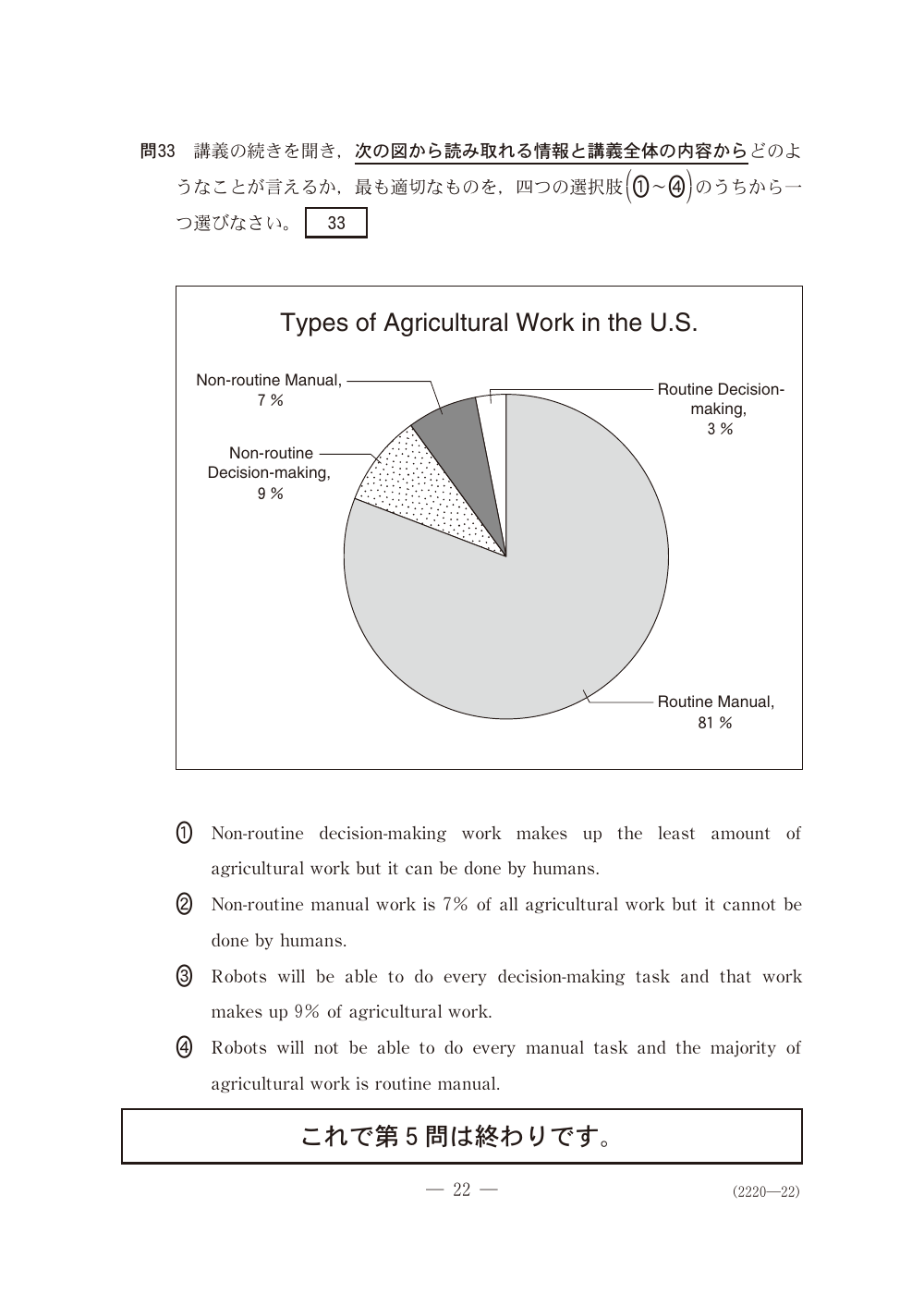
問33 講義の続きを聞き,次の図から読み取れる情報と講義全体の内容からどのようなことが言えるか,最も適切なものを,四つの選択肢(①〜④)のうちから一つ選びなさい。
状況: あなたは大学で,農業用ロボットに関する講義を,ワークシートにメモを取りながら聞いています。
スクリプト・和訳・解説を見る
スクリプト
Agricultural robot research could solve the problem of labor shortages and help farmers with their work.農業用ロボットの研究は,労働力不足の問題を解決し,農家の仕事を助ける可能性があります。
First, let's examine the kinds of jobs that people are doing in agriculture in the U.S.まず,アメリカの農業で人々がどのような仕事をしているかを調べてみましょう。
Look at this chart.この図を見てください。
You can see that only 12% of current jobs require decision-making.現在の仕事のうち,意思決定を必要とするものは12%にすぎないことがわかります。
解説
正解は④。講義でロボットにはできない肉体労働があると述べられており,図では定型的な肉体労働(Routine Manual)が81%と大部分を占めるから。決め手は講義の「robots have difficulty picking apples from trees of different shapes and sizes」と,図のRoutine Manual, 81%の組み合わせで,④の内容と正確に一致する。①は「最も少ない」のがNon-routine Decision-making(9%)ではなくRoutine Decision-making(3%)なので図と矛盾する。②は講義で非定型の肉体労働も人間が担い続けるとされており,cannot be done by humansが逆。③は「some non-routine decision-making work ... will still be done by humans」と矛盾し,講義の続きの「意思決定を必要とする仕事は12%」という数字とも合わない(9%は非定型の意思決定のみ)。コツ: 図表付きの問題は「図の数値の正誤」と「講義内容との整合」の両面からチェックし,数字の取り違えを狙った選択肢から消去していこう。
第6問A
二人の対話を聞き,それぞれの問いの答えとして最も適切なものを,四つの選択肢(①〜④)のうちから一つずつ選ぶ。問いの英文は冊子に書かれている。状況と問いを読む時間が与えられた後,音声が1回流れる。
問34 Which opinion did Sophie express during the conversation?
状況: 大学生のSophieとMarkが,留学生の歓迎会について話をしています。
スクリプト・和訳・解説を見る
スクリプト
Sophie: Hey, Mark. The international students will arrive next month. Let's plan a welcome party.ねえ,マーク。留学生たちが来月到着するわ。歓迎会を計画しましょうよ。
Mark: OK. We should invite all our friends so that everyone can get to know each other.いいね。みんながお互いを知り合えるように,友達を全員招待しようよ。
Sophie: Sure. In that case, we need a big place. Maybe we can have a party on campus. We could bring in drinks and order pizzas.そうね。それなら広い場所が必要ね。キャンパスでパーティーができるかもしれないわ。飲み物を持ち込んで,ピザを注文すればいいし。
Mark: But wait a second, the university has already planned an official welcome event on campus. It would be better to have a party somewhere else.でもちょっと待って。大学がもう公式の歓迎イベントをキャンパスで計画しているんだ。どこか別の場所でパーティーをする方がいいよ。
Sophie: That's true. Well, how about going to a restaurant in town?確かにそうね。じゃあ,町のレストランに行くのはどう?
Mark: Hmm, that might be too expensive. Hey, it'll be cherry blossom season, so it'd be nice to have a party outside.うーん,それは高すぎるかもしれないよ。そうだ,桜の季節になるから,外でパーティーをするのがいいんじゃないかな。
Sophie: You're right. What about the barbecue area in the park?そうね。公園のバーベキューエリアはどう?
Mark: That sounds nice. We can take some food and drinks there. It won't cost much, either.それはいいね。食べ物と飲み物を持って行けるし,お金もあまりかからないよ。
Sophie: Yeah, and we could all go to the supermarket together to buy everything. The international students would enjoy that.ええ。それに,みんなで一緒にスーパーへ必要な物を買いに行けるわ。留学生たちはそれを楽しんでくれると思うの。
Mark: All right!決まりだね!
解説
正解は①。ソフィーは,みんなでスーパーへ買い出しに行けば留学生が楽しんでくれるという意見を述べているから。決め手は「we could all go to the supermarket together to buy everything. The international students would enjoy that.」で,これが①のGoing shopping will be fun for the students.の言い換えになる。④の桜がすてきという意見はマークの発言(it'll be cherry blossom season, so it'd be nice to have a party outside)で,しかも場所はキャンパスではなく屋外。③の高くつくと言ったのもマークで,対象はピザではなくレストラン。②のような「不可能だ」という発言は誰もしていない。コツ: 「誰の意見か」を問う問題では,アイデアが出るたびに発言者名をメモし,内容と話者を対応させながら聞こう。
問35 Which statement would both of them agree with by the end of the conversation?
状況: 大学生のSophieとMarkが,留学生の歓迎会について話をしています。
スクリプト・和訳・解説を見る
スクリプト
Sophie: Hey, Mark. The international students will arrive next month. Let's plan a welcome party.ねえ,マーク。留学生たちが来月到着するわ。歓迎会を計画しましょうよ。
Mark: OK. We should invite all our friends so that everyone can get to know each other.いいね。みんながお互いを知り合えるように,友達を全員招待しようよ。
Sophie: Sure. In that case, we need a big place. Maybe we can have a party on campus. We could bring in drinks and order pizzas.そうね。それなら広い場所が必要ね。キャンパスでパーティーができるかもしれないわ。飲み物を持ち込んで,ピザを注文すればいいし。
Mark: But wait a second, the university has already planned an official welcome event on campus. It would be better to have a party somewhere else.でもちょっと待って。大学がもう公式の歓迎イベントをキャンパスで計画しているんだ。どこか別の場所でパーティーをする方がいいよ。
Sophie: That's true. Well, how about going to a restaurant in town?確かにそうね。じゃあ,町のレストランに行くのはどう?
Mark: Hmm, that might be too expensive. Hey, it'll be cherry blossom season, so it'd be nice to have a party outside.うーん,それは高すぎるかもしれないよ。そうだ,桜の季節になるから,外でパーティーをするのがいいんじゃないかな。
Sophie: You're right. What about the barbecue area in the park?そうね。公園のバーベキューエリアはどう?
Mark: That sounds nice. We can take some food and drinks there. It won't cost much, either.それはいいね。食べ物と飲み物を持って行けるし,お金もあまりかからないよ。
Sophie: Yeah, and we could all go to the supermarket together to buy everything. The international students would enjoy that.ええ。それに,みんなで一緒にスーパーへ必要な物を買いに行けるわ。留学生たちはそれを楽しんでくれると思うの。
Mark: All right!決まりだね!
解説
正解は①。二人は最終的に,公園のバーベキューエリア,つまりキャンパスの外でパーティーを開くことで合意しているから。決め手はマークの「It would be better to have a party somewhere else.」にソフィーが「That's true.」と同意し,公園の案に「That sounds nice.」「All right!」と落ち着いた流れで,これが①のoff campus(キャンパス外で)の言い換えになる。④のレストランは「too expensive(高すぎるかもしれない)」という理由で退けられた案。③の公式イベントは大学がすでに計画しているものであり,二人が企画するものではない。②は,最終的に食べ物と飲み物は注文ではなく持参して行く(take some food and drinks there)ことになった。コツ: 会話の結論を問う問題では,提案→反対→代案の流れを追い,最後に両者が肯定的な返事をした案だけを残そう。
第6問B
四人の会話を聞き,それぞれの問いの答えとして最も適切なものを,選択肢のうちから一つずつ選ぶ。状況と問いを読む時間が与えられた後,音声が1回流れる。
問36 会話が終わった時点で,今回荷物を預け入れないことに決めた人を,四つの選択肢(①〜④)のうちから一つ選びなさい。
状況: 四人の学生(Edward, Susie, Barry, Kyoko)が,今度の旅行で飛行機に乗る際の預け入れ荷物(checked luggage)について話し合っています。
スクリプト・和訳・解説を見る
スクリプト
Edward: Hey, Susie. I'm really excited about our trip to Hawaii!やあ,スージー。ハワイ旅行が本当に楽しみだよ!
Susie: Me, too. But yesterday I read an article about luggage troubles at the airport. Now I'm a little worried. Have you had any problems with your luggage, Edward?私もよ。でも昨日,空港での荷物トラブルについての記事を読んだの。今は少し心配だわ。エドワードは荷物のトラブルにあったことはある?
Edward: Yeah, in fact, my bags were lost twice!うん,実はかばんを2回もなくされたんだ!
Susie: Really? Twice?本当に?2回も?
Edward: Yes. So I've decided to put everything into one backpack and carry it with me all the time. That way, I won't lose it. How about you, Barry?そうなんだ。だから,全部を一つのバックパックに入れて,ずっと自分で持ち歩くことにしたんだ。そうすればなくさないからね。バリーはどうするの?
Barry: You're very unlucky, Edward! I heard that, most of the time, bags are just delayed rather than lost completely. So, I don't mind checking in my suitcase. Luggage almost always comes back in the end.エドワードはずいぶん運が悪いね!ほとんどの場合,かばんは完全になくなるのではなく,遅れて届くだけだと聞いたよ。だから,僕はスーツケースを預けても構わないんだ。荷物はほぼ必ず最後には戻ってくるからね。
Edward: You mean, you don't worry about it at all?つまり,全然心配していないってこと?
Barry: No, I haven't had any problems. What do you think, Kyoko?うん,トラブルにあったことは一度もないよ。キョウコはどう思う?
Kyoko: Me? Well, there's always a chance that something unexpected will happen. That's why I'm not going to put anything valuable in my checked luggage.私?そうね,予想外のことが起こる可能性は常にあるわ。だから,預け入れ荷物には貴重品を入れないつもりよ。
Barry: That's smart.それは賢いね。
Kyoko: Yeah. I use an orange tag on my suitcase so that no one takes mine by mistake. What are you going to do, Susie?ええ。誰かが間違えて私のを持って行かないように,スーツケースにはオレンジ色のタグをつけているの。スージーはどうするの?
Susie: Well, I won't be able to pack all my things in one backpack like Edward does. But I will carry my valuables with me, and I'm going to put a shiny tag on my suitcase.そうね,私はエドワードみたいに荷物全部を一つのバックパックに詰めることはできないわ。でも,貴重品は身につけて持ち歩いて,スーツケースには光るタグをつけるつもりよ。
Kyoko: There you go! It should be OK.その調子!それなら大丈夫よ。
解説
正解は①(Edward)。エドワードだけが荷物を預けず,すべて機内に持ち込むと決めているから。決め手は「I've decided to put everything into one backpack and carry it with me all the time.」で,carry it with me all the time(ずっと持ち歩く)は預け入れをしないことを意味する。バリーは「I don't mind checking in my suitcase.」とスーツケースを預けることを明言している。キョウコも貴重品を入れないだけで,オレンジのタグをつけたスーツケースを預ける前提で話しており,スージーも「I won't be able to pack all my things in one backpack like Edward does」と述べて,光るタグをつけたスーツケースを預けるつもり。コツ: 複数人の会話では,人物ごとに「預ける/預けない」を表にメモし,like Edward does(エドワードのように)のような比較表現からも各人の判断を補強しよう。
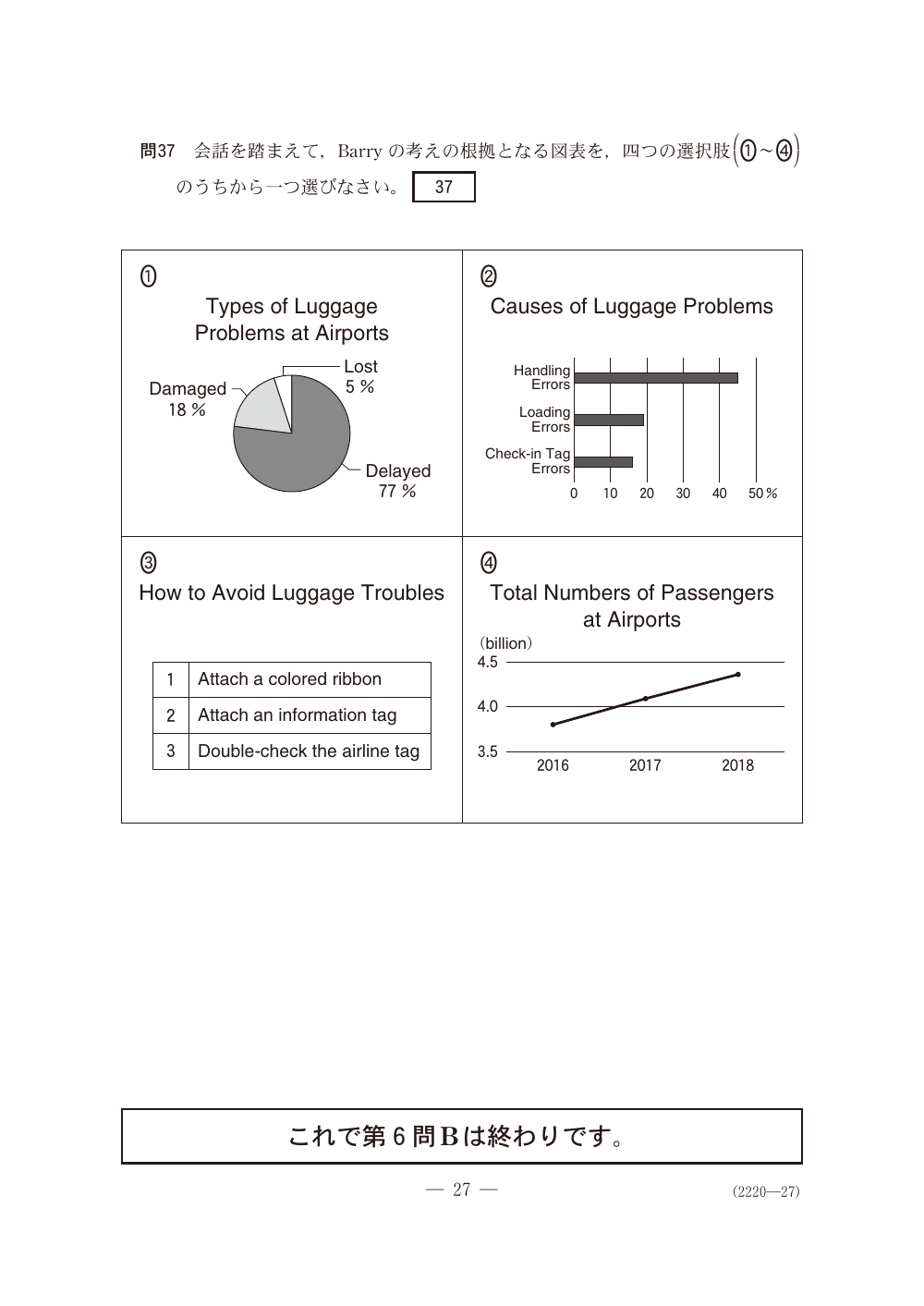
問37 会話を踏まえて,Barry の考えの根拠となる図表を,四つの選択肢(①〜④)のうちから一つ選びなさい。
状況: 四人の学生(Edward, Susie, Barry, Kyoko)が,今度の旅行で飛行機に乗る際の預け入れ荷物(checked luggage)について話し合っています。
スクリプト・和訳・解説を見る
スクリプト
Edward: Hey, Susie. I'm really excited about our trip to Hawaii!やあ,スージー。ハワイ旅行が本当に楽しみだよ!
Susie: Me, too. But yesterday I read an article about luggage troubles at the airport. Now I'm a little worried. Have you had any problems with your luggage, Edward?私もよ。でも昨日,空港での荷物トラブルについての記事を読んだの。今は少し心配だわ。エドワードは荷物のトラブルにあったことはある?
Edward: Yeah, in fact, my bags were lost twice!うん,実はかばんを2回もなくされたんだ!
Susie: Really? Twice?本当に?2回も?
Edward: Yes. So I've decided to put everything into one backpack and carry it with me all the time. That way, I won't lose it. How about you, Barry?そうなんだ。だから,全部を一つのバックパックに入れて,ずっと自分で持ち歩くことにしたんだ。そうすればなくさないからね。バリーはどうするの?
Barry: You're very unlucky, Edward! I heard that, most of the time, bags are just delayed rather than lost completely. So, I don't mind checking in my suitcase. Luggage almost always comes back in the end.エドワードはずいぶん運が悪いね!ほとんどの場合,かばんは完全になくなるのではなく,遅れて届くだけだと聞いたよ。だから,僕はスーツケースを預けても構わないんだ。荷物はほぼ必ず最後には戻ってくるからね。
Edward: You mean, you don't worry about it at all?つまり,全然心配していないってこと?
Barry: No, I haven't had any problems. What do you think, Kyoko?うん,トラブルにあったことは一度もないよ。キョウコはどう思う?
Kyoko: Me? Well, there's always a chance that something unexpected will happen. That's why I'm not going to put anything valuable in my checked luggage.私?そうね,予想外のことが起こる可能性は常にあるわ。だから,預け入れ荷物には貴重品を入れないつもりよ。
Barry: That's smart.それは賢いね。
Kyoko: Yeah. I use an orange tag on my suitcase so that no one takes mine by mistake. What are you going to do, Susie?ええ。誰かが間違えて私のを持って行かないように,スーツケースにはオレンジ色のタグをつけているの。スージーはどうするの?
Susie: Well, I won't be able to pack all my things in one backpack like Edward does. But I will carry my valuables with me, and I'm going to put a shiny tag on my suitcase.そうね,私はエドワードみたいに荷物全部を一つのバックパックに詰めることはできないわ。でも,貴重品は身につけて持ち歩いて,スーツケースには光るタグをつけるつもりよ。
Kyoko: There you go! It should be OK.その調子!それなら大丈夫よ。
解説
正解は①。バリーの考えの根拠は,荷物は完全に紛失するより遅延で済むことがほとんどだという事実だから。決め手は「most of the time, bags are just delayed rather than lost completely」で,Delayed 77%・Lost 5%を示す①の円グラフ(Types of Luggage Problems at Airports)がこの発言をそのまま裏づける。②のトラブルの原因や③の回避方法は,タグの話をしたキョウコやスージーの行動には関係しても,バリーの「遅延がほとんど」という主張とは対応しない。④の旅客数の推移も遅延と紛失の割合とは無関係。コツ: 図表の根拠を問う問題では,発言中の比較表現(A rather than B)と,図の項目名・数値の大小関係(DelayedがLostよりはるかに大きい)を対応させよう。